Quick Answer: Choose your startup HRIS by whether you can automate it. BambooHR ($10–$25 per employee/month) gives customers self-serve API keys and signed webhooks, which makes it the strongest fit for n8n or Make stacks. Deel suits global-first hiring and has a self-serve API. Gusto is excellent at US payroll but offers no API for customers’ own systems.
Disclosure: Operant Solo is reader-supported. We may earn an affiliate commission when you purchase through links on this page, at no additional cost to you. Recommendations are based on independent testing and evaluation.
Every startup reaches the same point. Someone signs an offer letter, and then a founder spends 40 minutes copying their name, email, start date and manager into payroll, Google Workspace, Slack and the onboarding tracker. By the tenth hire, that copy-paste loop is a real operational tax.
Most “best HRIS for startups” lists rank tools by HR feature count. This guide ranks them by a question builders care about more: can you connect the HRIS to the rest of your stack without a vendor-approved partnership? By the end, you’ll know which of five platforms fits your stage, what it actually costs at 5, 15 and 30 employees, and how to build a working new-hire automation in n8n.
Methodology: We captured pricing from each vendor’s public pricing page on September 24, 2026. API and webhook details come from each vendor’s official developer documentation as of the same date. Rippling and HiBob don’t publish pricing, so they’re marked as sales-quoted, and we don’t estimate their prices.
What an HRIS Does for a 5–50 Person Startup
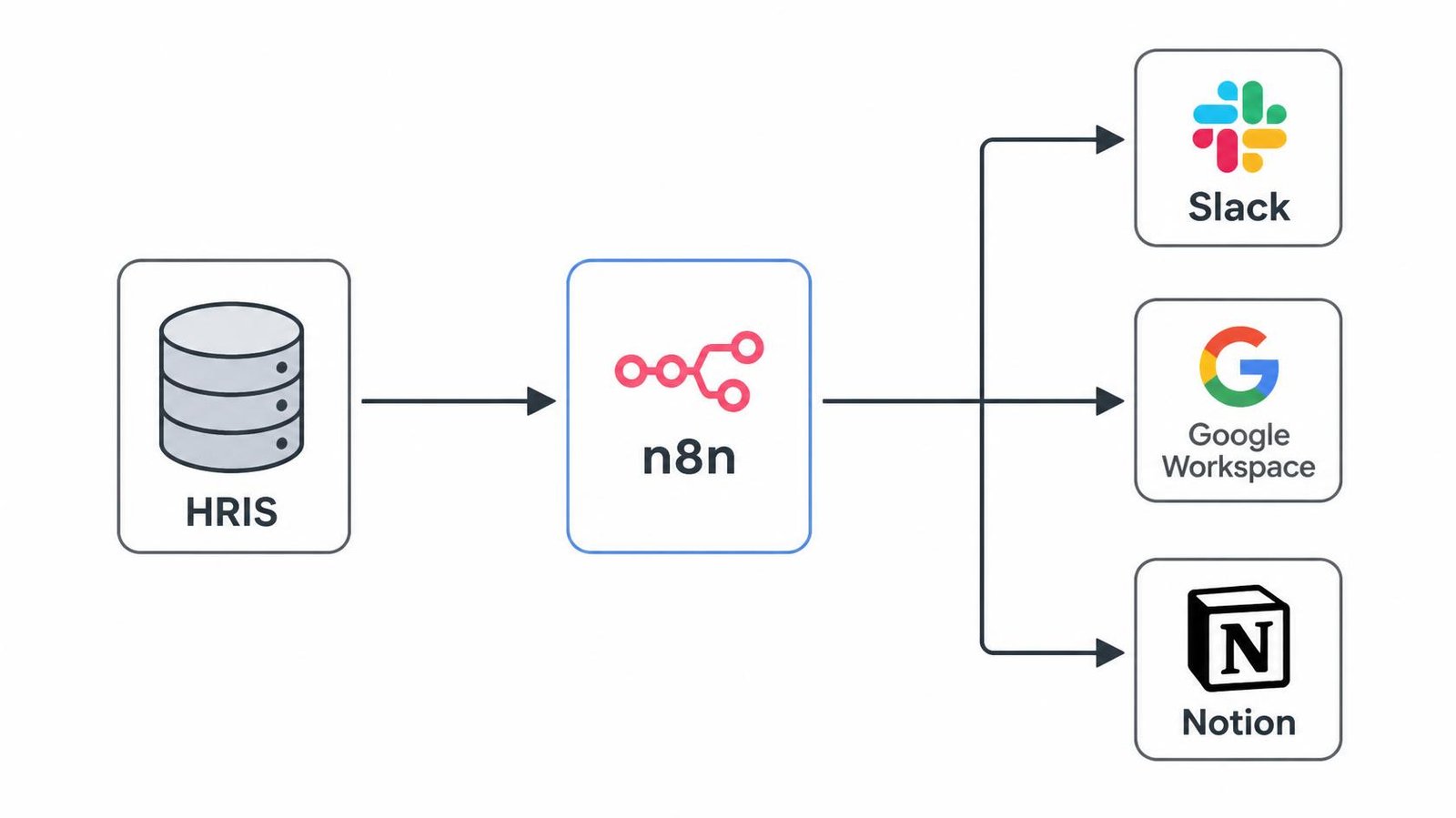
An HRIS (Human Resource Information System) is a system of record that lets startups store, update and act on employee data from one place. It does this by centralizing records, time off, onboarding and, often, payroll.
For a small team, the value isn’t HR sophistication. It’s having one authoritative employee record that every other tool reads from. Platforms fall into three models:
- Payroll-first (Gusto): runs payroll and tax filing well, with HR features layered on top.
- HR-first (BambooHR, HiBob): strong employee records, onboarding and time off, with payroll as an add-on or via integration.
- Employer-of-record or PEO (Deel): the vendor becomes the legal employer or co-employer and handles compliance, at a much higher per-person cost.
6 Signs You’ve Outgrown the Spreadsheet
- You’re hiring in more than one state or country.
- Employee data lives in 3+ tools and gets copied by hand.
- PTO is approved over Slack, and nobody knows the real balance.
- Offer letters and contracts are scattered across Drive folders.
- A new hire has waited more than a day for their accounts.
- A founder is the de facto HR department.
If three or more apply, the cost of a new tool is lower than the cost of the manual work.
The Automation Readiness Matrix
| Tool | Best for | Entry price (checked Sep 24, 2026) | API for your own systems | Webhooks | Native n8n node | Native Make app |
|---|---|---|---|---|---|---|
| BambooHR | HR-first teams that want automation | $10/employee/mo (Core) | Yes, self-serve API keys | Yes: global and API-created | Yes | Yes |
| Deel | Global contractors and EOR hires | $49/contractor/mo; $125/US PEO employee/mo | Yes, self-serve tokens | Yes | No (HTTP Request node) | Yes |
| HiBob | Culture-led teams at 50+ people | Sales-quoted | Yes, via service users | Yes | No (HTTP Request node) | Yes |
| Rippling | All-in-one HR + IT + payroll | Sales-quoted | Yes, customer API keys | Yes | No (HTTP Request node) | No |
| Gusto | US payroll-first teams | $49/mo + $6/person (Solo plan) | No | Partner apps only | No | No |
Which HRIS has the best API for startups?
BambooHR has the most builder-friendly setup for a small team. You generate an API key from your own profile, n8n ships a native node for it, and it sends signed webhooks on employee events. Deel is a close second: you generate organization or personal tokens yourself, and Make has a native Deel app. Gusto is the outlier, because it doesn’t give customers API access to their own account.
The 5 Platforms, Compared Against a Builder’s Stack
BambooHR: Best for startups that want an automatable system of record
BambooHR is an HR-first HRIS that lets startups manage employee records, hiring, onboarding and time off from one database.
Pricing: Core is $10, Pro is $17 and Elite is $25 per employee per month (USD). All three tiers show a “Get Quote” button, and the page notes that volume and non-profit discounts are available. Core covers HR data and reporting, hiring and onboarding, time off and benefits tracking, and an AI assistant. Pro adds performance management. Elite adds compensation management and custom dashboards.
API and automation reality:
- API keys: You generate a key by clicking your profile image, choosing API Keys, and adding a new key. BambooHR recommends OAuth 2.0 for production integrations, so treat raw keys as fine for internal automations.
- Two webhook types: Admins configure global webhooks in the settings UI, and these watch a predefined set of fields. Permissioned webhooks are created through the API, and they can only access the fields the creating user has permission to see.
- Signed requests: Webhooks are signed with SHA-256 HMAC using a private key, so you can verify each request really came from BambooHR.
- Native n8n node: It can create, get, update and list employees, and manage employee documents and company files.
Gotcha: A new-hire event doesn’t carry the employee’s details. The employee.created payload includes only the company ID and employee ID, and it fires together with an employee.updated event. You need a follow-up “Get Employee” call, and you need to dedupe the two events (see the build below).
Deel: Best for startups hiring internationally first
Deel is a global employment platform that lets startups hire and pay contractors and employees across borders. It does this by acting as the employer of record, the contractor of record, or a US PEO.
Pricing:
- Find talent (ATS): $14 per worker per month
- Contractors: $49 per contractor per month
- Contractor of record: $325 per contractor per month
- US PEO: $125 per employee per month
- EOR: $599 per employee per month
Every tier routes you to “Book a demo.”
API and automation reality:
- Tokens: You generate tokens yourself from the Developer Center. Organization tokens reach all org resources, and personal tokens are limited to what that user can access.
- Webhooks: Deel exposes endpoints to create and manage webhook subscriptions.
- Make: Make has native Deel modules, which connect using a Deel API key.
Gotcha: EOR pricing is a different category from software pricing. At $599 per employee, EOR only makes sense when the alternative is setting up a foreign legal entity.
HiBob: Best for culture-focused teams past 50 people
HiBob (Bob) is a modern HRIS that lets growing companies manage people data, time off, performance and compensation from one platform.
Pricing: Sales-quoted. There’s no public price list.
API and automation reality:
- Service users: You authenticate API calls with service users, which have their own permissions, aren’t tied to real employees, and can’t log in to Bob.
- Webhooks: Bob’s webhooks can fire on events like a new employee being created or a time-off request being submitted.
- OAuth is partner-only: OAuth apps are reserved for approved marketplace partners. Customers building their own integrations use service users.
Gotcha: HiBob doesn’t publish exact rate limits. When you exceed them, it returns a 429 with a Retry-After header, so build backoff into any sync.
Rippling: Best for teams that want HR, IT and payroll in one record
Rippling is a workforce platform that lets companies run HR, payroll, device management and app provisioning from a single employee record.
Pricing: Sales-quoted. There’s no public price list.
API and automation reality:
- Customer API keys: Customers can create their own API keys to connect internal systems.
- Scoped permissions: Token permissions are capped by the permissions of the user who creates the token.
Gotcha: Rippling’s native IT provisioning overlaps with what you’d build in n8n. If you buy Rippling for its app provisioning, you may not need the automation layer for onboarding at all. That changes the math: compare Rippling’s quote against “HR-first HRIS plus n8n,” not against the HRIS alone.
Gusto: Best for US teams where payroll is the bottleneck
Gusto is a payroll-first platform that lets US businesses run payroll, file taxes automatically, and administer benefits.
Pricing: The Solo plan is $49/month plus $6/month per person. It’s built for solopreneurs who need payroll, S corp compliance support, and the option to pay contractors. It includes a reasonable-salary calculator and access to a solo 401(k), health benefits, bill pay and contractor payments.
Gusto’s entry team plan uses the same structure: $49/month base plus $6/month per person.
API and automation reality: Gusto’s API is for partners building integrations, not for customers. Gusto states it currently doesn’t support API access for customers who want to connect their own company systems to their account. Production API keys also require a pre-approval application and a QA review.
Gotcha: This is the single biggest automation constraint in the category, and competitor lists rarely mention it. If your plan is “Gusto plus n8n,” you’ll depend on Gusto’s pre-built integrations or a third-party unified API.
What It Actually Costs at 5, 15, and 30 Employees
Prices are calculated from published list prices captured September 24, 2026. They exclude discounts, setup fees and add-ons.
| Plan | 5 people/mo | 15 people/mo | 30 people/mo | Notes |
|---|---|---|---|---|
| BambooHR Core | $50 | $150 | $300 | Quote-confirmed; volume discounts available |
| BambooHR Pro | $85 | $255 | $510 | Adds performance management |
| BambooHR Elite | $125 | $375 | $750 | Adds compensation and custom analytics |
| Deel Contractors | $245 | $735 | $1,470 | Per contractor, not employee |
| Deel US PEO | $625 | $1,875 | $3,750 | Co-employment with benefits included |
| Deel EOR | $2,995 | $8,985 | $17,970 | Legal employment abroad, no entity needed |
| Gusto (team plans) | $79 | $80 | $180 | $49 base + $6/person |
| Rippling | Quote | Quote | Quote | No public pricing |
| HiBob | Quote | Quote | Quote | No public pricing |
The tier jump to watch: BambooHR’s Core-to-Pro upgrade adds $7 per employee per month. At 30 people, that’s $210/month, or $2,520/year, mostly to unlock performance management. If you run reviews in a lightweight tool or a Notion template, Core plus automation covers most startups up to about 50 people.
Build It: Auto-Onboard New Hires from BambooHR to Slack and Google Workspace with n8n
This workflow turns “new employee added in BambooHR” into a Google Workspace account, a Slack welcome message and a tracker row, with no copy-paste.
Node chain: Webhook → Crypto (HMAC verify) → IF (signature valid and not duplicate) → BambooHR: Get Employee → Google Workspace Admin: Create User → Slack: Send Message → Google Sheets: Append Row
- Create an n8n account or self-host an instance. If you don’t have one yet, start with n8n here. For the cloud vs self-hosting trade-offs, see our n8n review.
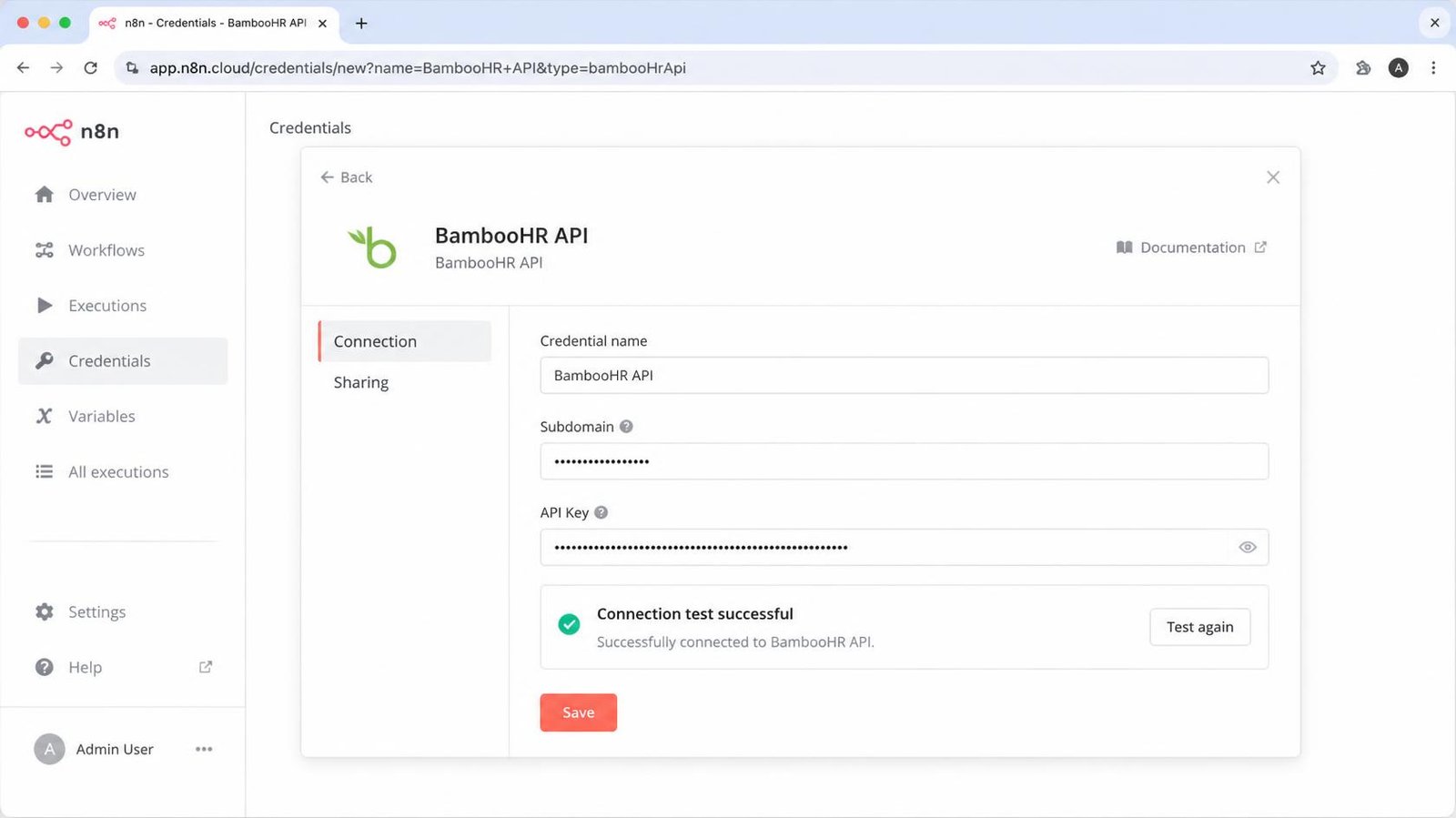
- Create the BambooHR credential. In BambooHR, open your profile menu, go to API Keys, and add a new key. In n8n, create a BambooHR API credential with that key and your company subdomain (the
yourcompanypart ofyourcompany.bamboohr.com).
- Add a Webhook node. Set the method to POST, and turn on Raw Body in the options. HMAC verification needs the exact bytes BambooHR sent, not a re-serialized JSON object. Copy the production URL.
- Register the webhook in BambooHR. Point a webhook at your n8n URL and subscribe it to new-employee events. Save the private key BambooHR gives you for signing.
- Verify the signature. Use a Crypto node set to HMAC, SHA256, with your private key as the secret, then compare its output to the signature header in an IF node. Reject anything that doesn’t match.
- Dedupe the double event. Because creation fires both
employee.createdandemployee.updated, add a check keyed onemployeeId: skip the run if that ID was processed in the last 10 minutes. A simple approach is a Google Sheets lookup or n8n’s static workflow data. - Fetch the full record. Add a BambooHR node with Resource set to Employee, Operation set to Get, and the Employee ID mapped from the webhook payload.
| Setting | Value |
| Resource | Employee |
| Operation | Get |
| Employee ID | {{ $json.body.data.employeeId }} (drag it in from the Webhook node’s output) |
| Fields to return | First name, last name, work email, job title, department, hire date, supervisor |
- Create the Google Workspace user. Add a Google Workspace Admin node that creates a user from
firstName,lastNameand a generated primary email. Force a password change at first login. - Post the Slack welcome. Send a message to your #team channel, and a DM to the supervisor with the start date. If you want a manager to approve access before accounts go live, add an approval step. Our n8n human-in-the-loop tutorial shows the Slack approval-button pattern.
- Log it. Append a row to your onboarding tracker in Google Sheets or Notion with the employee ID, name, start date, accounts created and a timestamp.
- Test with a dummy employee. Create a test hire in BambooHR, then confirm in n8n’s execution log that exactly one run completed. Delete the test user afterward.
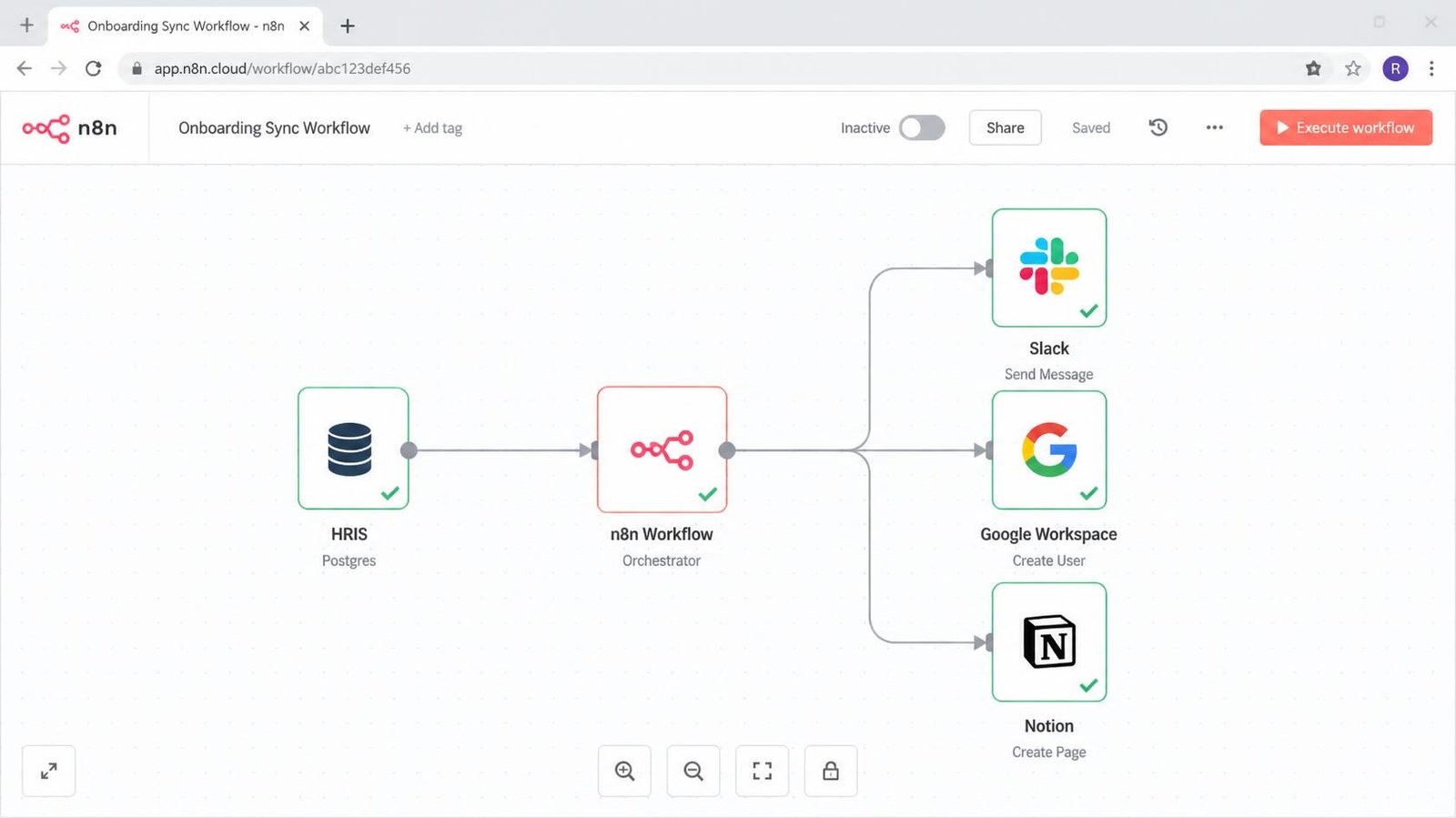
Using Deel instead? The same pattern works with a Deel webhook and an HTTP Request node, or with Make’s native Deel modules if you prefer Make’s visual builder. For the same onboarding pattern applied to clients instead of employees, see how to automate client onboarding.
Build this workflow with n8n. Self-host it on a small VPS or start on n8n Cloud. The BambooHR node is built in, so there’s no custom code beyond signature checks. Get started with n8n →
Gotchas the Vendor Pages Skip
- “Has an API” doesn’t mean “you can use the API.” Gusto’s API is partner-only for production. HiBob reserves OAuth for approved partners, so customers use service users instead. Always check who the API is for.
- Permission-scoped tokens fail silently. BambooHR’s API-created webhooks only see fields the creating user can access, and Rippling caps tokens at the creator’s permissions. Create integrations from an admin-level or dedicated integration user, not a manager’s account.
- “Get Quote” often means the listed price isn’t final. BambooHR shows per-employee prices but still routes through a quote. Budget for the list price and treat discounts as upside.
- Contractor pricing isn’t employee pricing. Deel’s $49 contractor tier and $599 EOR tier solve different legal problems. Classify workers correctly before comparing.
- Migration cost is the hidden line item. Moving payroll mid-year means reconciling tax filings across two systems. Pick the tool you won’t need to leave within 24 months.
The Verdict
- Choose BambooHR if you want an HRIS you can wire into n8n or Make today with no partner approval. It has the best automation access per dollar in this list.
- Choose Deel if your first hires are contractors or employees outside the US. Its self-serve API and native Make app make automation straightforward.
- Choose Gusto if US payroll accuracy is your main constraint and you’re comfortable relying on its pre-built integrations instead of your own automations.
- Choose Rippling or HiBob if you’re past about 50 people, have budget for a sales-led purchase, and want either IT provisioning built in (Rippling) or stronger culture and analytics tooling (HiBob).
Who This Is For / Who Should Skip It
This guide is for:
- Founders making their first 3–50 hires who want the employee record to drive everything else
- Technical founders and ops leads already running n8n, Make or Zapier
- Remote-first teams that need accounts provisioned before day one
Skip it if:
- You’re a solo founder with no employees. A contractor payment tool or Gusto’s Solo plan covers you.
- You have 200+ employees and a dedicated HR team. You’re buying a different category of software.
FAQ
Does a startup need an HRIS before its first hire?
Usually not. Before your first W-2 employee, a payroll tool and a shared folder are enough. Adopt an HRIS when you hit the triggers above, typically around 5–10 people or your first out-of-state hire.
Is there a free HRIS for startups?
None of the five plans compared here are free on the pricing pages we captured. Open-source HRIS software exists, but you take on hosting, security and compliance yourself, which rarely pays off for a team without dedicated ops capacity.
Can I connect BambooHR to Slack without Zapier?
Yes. n8n has a native BambooHR node, and BambooHR can send signed webhooks to an n8n Webhook node. The build section above walks through a new-hire-to-Slack workflow end to end.
Gusto or BambooHR for a 10-person startup?
Choose Gusto if payroll and tax filing are the job you need done. Choose BambooHR if you need a clean employee record that other tools read from. Many teams run both, but remember Gusto doesn’t give you API access for custom automations.
How much does an HRIS cost per employee?
From the prices captured here, it ranges from $10 per employee per month for BambooHR Core to $599 for Deel’s EOR service. Rippling and HiBob require a quote.