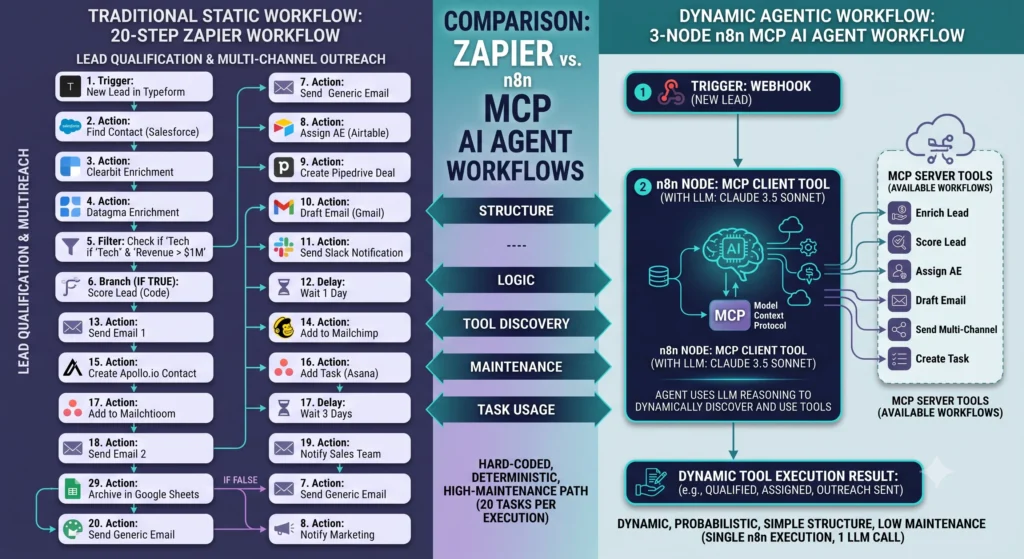
The Death of the Static API Connector
For the past decade, automation engineering relied on static API connectors. If you wanted to move data from a CRM to a database, you explicitly defined every field mapping, every transformation step, and every error-handling loop. This paradigm is now obsolete. The introduction of the Model Context Protocol (MCP) by Anthropic, and its immediate adoption by n8n, fundamentally alters how machines interact with software.
An n8n mcp integration bridges the gap between large language models and local infrastructure. Rather than forcing a developer to map exact api calls to retrieve a specific file, MCP allows the ai model to browse your local file system, query your internal databases, and execute actions autonomously based on high-level natural language commands.
Quick Answer: The model context protocol n8n integration allows developers to build truly autonomous n8n ai agents. Instead of building rigid, step-by-step logic paths, developers define a set of tools (via MCP servers) and allow the AI to utilize dynamic automation routing to figure out the execution path itself. For technical teams, this architecture ends the n8n vs zapier 2026 debate entirely, establishing n8n as the undisputed operating system for enterprise-grade ai powered automation.
This guide explores the technical architecture of MCP, how to configure it within your n8n instance, and how to deploy autonomous agents that securely access your internal data.
Disclosure: Operant Solo is reader-supported. We may earn an affiliate commission when you purchase through links on this page, at no additional cost to you. Recommendations are based on independent testing and evaluation.
What is the Model Context Protocol?
The Model Context Protocol (MCP) is an open standard designed to solve the context bottleneck in AI. Before MCP, if an ai assistant needed context from your company’s proprietary GitHub repository, you had to manually copy-paste the code into the chat window, or build a highly brittle custom RAG (Retrieval-Augmented Generation) pipeline.
MCP standardizes how an AI connects to any data source. By running an MCP Server locally or on your cloud infrastructure, you grant the AI permission to fetch exactly the context it needs, securely, exactly when it needs it. When this protocol is embedded into an orchestration layer like n8n, the implications are staggering.
Transitioning to Dynamic Automation Routing
Traditional automated workflows rely on Directed Acyclic Graphs (DAGs). You connect Node A to Node B. If a condition is met, the workflow goes to Node C; otherwise, it goes to Node D.
An n8n mcp integration enables dynamic automation routing. Instead of drawing lines between nodes, you provide the n8n ai agents with a goal (e.g., “Audit the new employee’s access rights”) and a toolkit of MCP servers (Google Workspace MCP, Slack MCP, PostgreSQL MCP). The AI analyzes the goal, decides which tools to use, executes the API calls, evaluates the response, and determines the next step autonomously. The rigid DAG is replaced by fluid, intelligent reasoning.
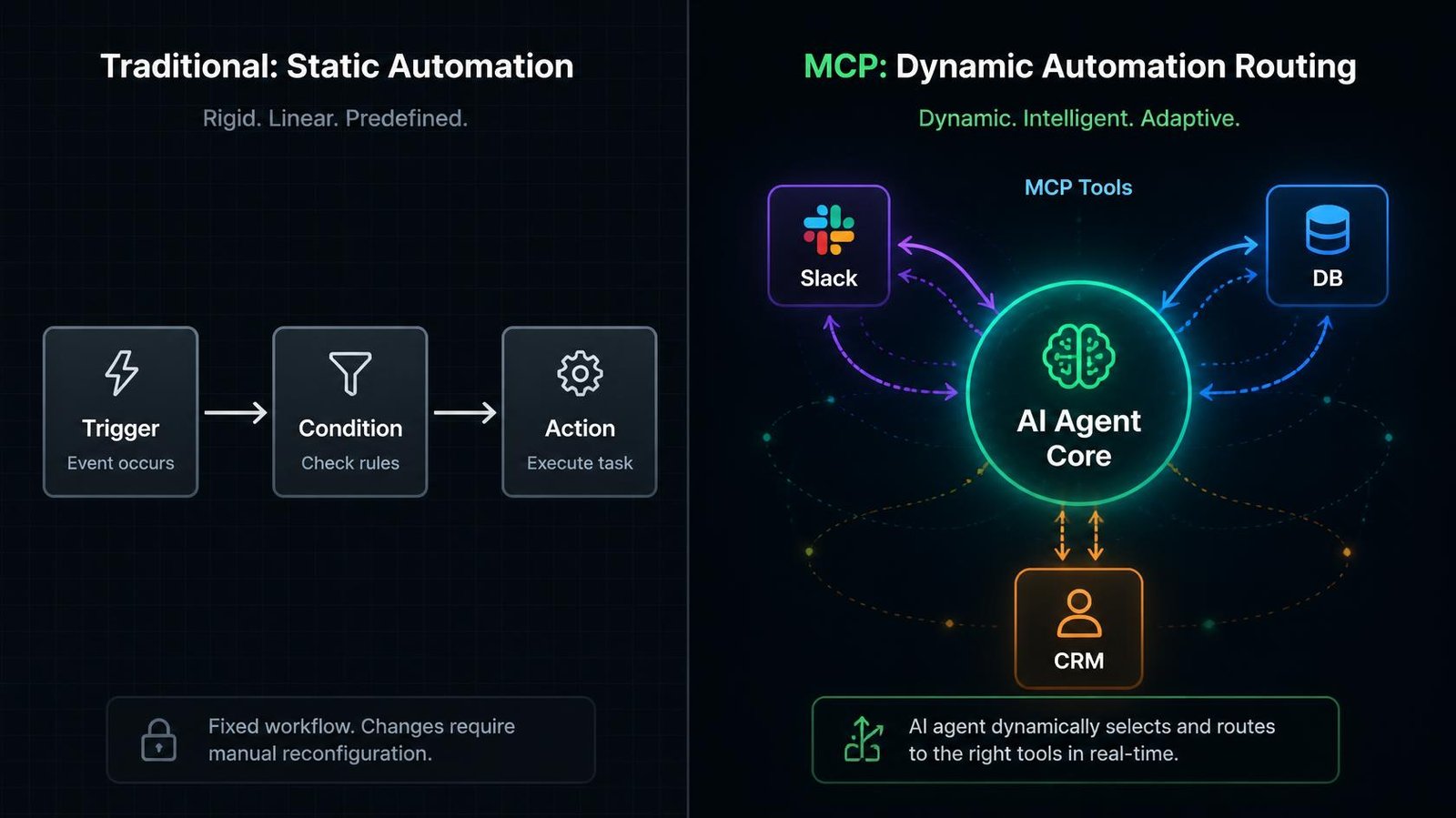
Configuring the n8n MCP Integration
Deploying MCP within your infrastructure requires a structured setup. You must configure both the MCP Server (which exposes your local tools) and the MCP Client (n8n, which utilizes the tools).
Step 1: Deploying the MCP Server
MCP Servers are lightweight applications. You can run them locally on your machine or deploy them via Docker. For example, if you want your ai agents to query your proprietary MySQL database, you deploy the official SQL MCP Server. You provide the server with the database credentials. The server translates the AI’s natural language requests into highly optimized SQL queries, executes them, and returns the data securely.
Step 2: Connecting to Your n8n Instance
Once your MCP Server is running, you must expose it to n8n. Inside your self-hosted n8n instance, navigate to the ai nodes section. You add an “MCP Client” node and provide the connection URL to your running server.
Step 3: Security and Full Control
Security is the primary reason technical users prefer MCP over raw API integrations. When an AI generates api calls, there is a risk of catastrophic hallucination (e.g., the AI deciding to execute a DROP TABLE command).
Because MCP is inherently local, you maintain full control over the permission boundaries. You configure the MCP server to act in a strict read-only capacity, or you require manual human approval via n8n’s wait nodes before any destructive action is executed. Your proprietary data never sits in a third-party vector database; it remains secure behind your firewall.
Building n8n AI Agents for the Real World
The true power of model context protocol n8n architectures is realized when building complex agentic systems. Let us examine a high-value deployment.
The Autonomous Code Reviewer
A software development agency wants to automate pull request (PR) reviews.
- The Traditional Approach: Build a webhook that triggers when a PR is opened. Use an HTTP request node to fetch the code diff from GitHub. Pass the diff to an LLM. Output the response to Slack. If the code is too large, the workflow crashes due to token limits.
- The MCP Approach: Create an autonomous agent in n8n. Connect the GitHub MCP Server and the Slack MCP Server. When a PR is opened, the agent activates. It uses the GitHub MCP to autonomously navigate the repository, reading not just the diff, but the surrounding architecture files to understand the context. It detects a security flaw, uses the Slack MCP to instantly notify the senior engineer, and suggests the exact remediation code.
Advanced Error Handling
When ai agents execute tasks, APIs occasionally fail. In a traditional workflow, an API timeout crashes the entire sequence unless you build exhaustive error handling branches. With dynamic automation routing, if the GitHub MCP server times out, the agent recognizes the failure autonomously, pauses, and retries the connection without requiring custom error-handling nodes.
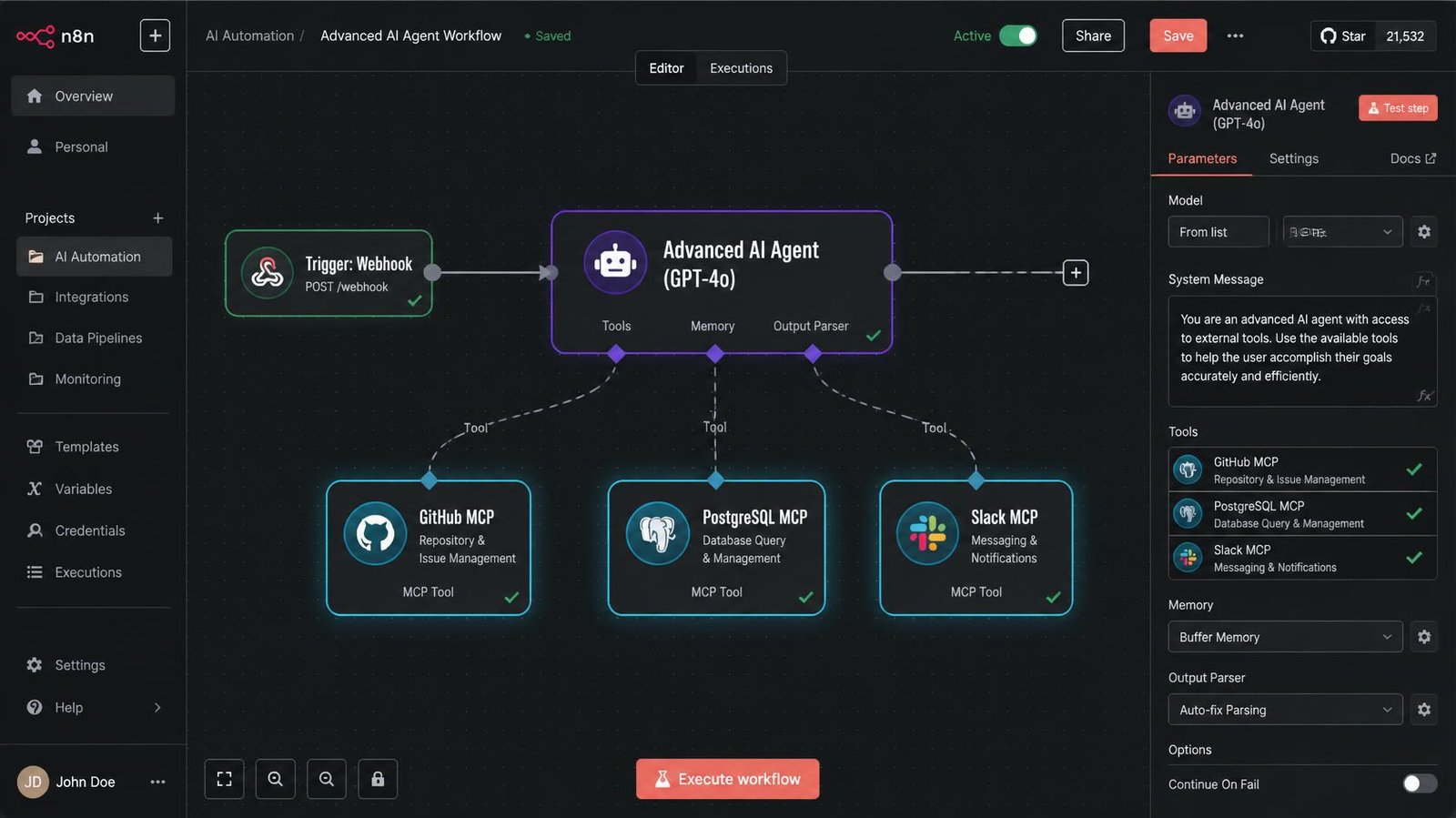
The n8n vs Zapier 2026 Debate Concluded
For years, the automation industry debated the merits of automation tools. Zapier won the mainstream market through simplicity, while n8n captured the developer market through flexibility. The introduction of MCP officially ends the n8n vs zapier 2026 debate for serious engineering teams.
The Limitation of Zapier’s Black Box
Zapier operates as a closed ecosystem. They must manually build and maintain every integration on their platform. While they offer native AI features, the AI is severely restricted by Zapier’s rigid execution paths. You cannot easily grant a Zapier AI agent direct, secure access to your local, behind-the-firewall database.
The Open Source Advantage
n8n is fair-code and heavily embraces the open source ethos. Because MCP is an open standard, the global developer community is currently building hundreds of specialized MCP servers. You do not have to wait for n8n to officially support a new SaaS platform. If an MCP server exists for it on GitHub, you can plug it into your n8n instance immediately.
For technical teams requiring absolute data sovereignty, infinite scalability, and the ability to deploy true ai capabilities on internal networks, Zapier is no longer a viable option. The n8n mcp integration elevates n8n from an automation platform to a localized AI operating system.
Accelerating Deployment with Workflow Templates
You do not need to architect these advanced systems from absolute scratch. The n8n community provides exhaustive workflow templates specifically designed for MCP architectures.
By importing these templates, you can instantly deploy pre-configured ai nodes and memory management systems. Your only technical requirement is connecting the MCP client to your local server. These templates drastically lower the barrier to entry, allowing agencies and developers to deploy production-ready n8n ai agents in a matter of hours rather than weeks.
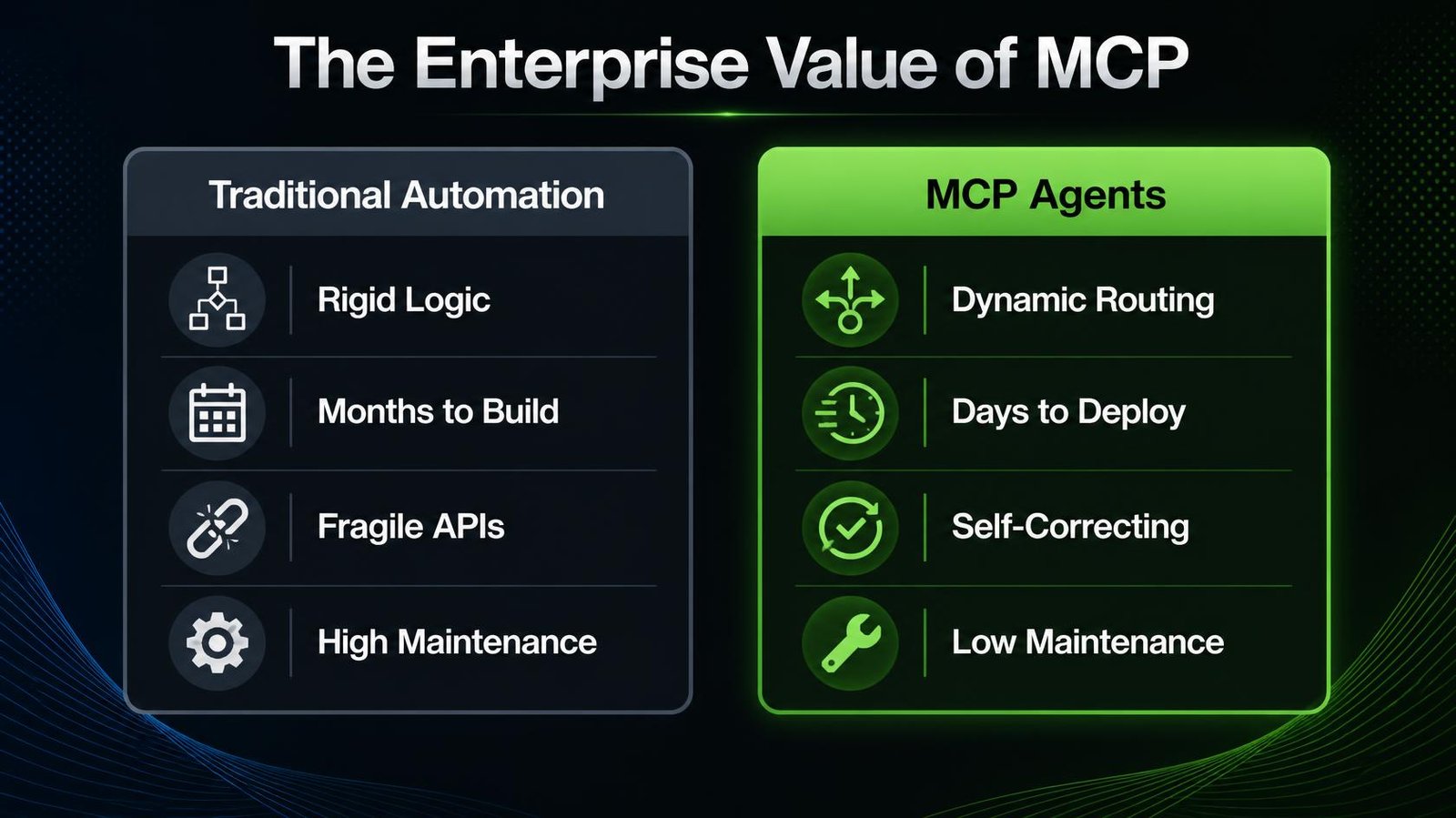
Conclusion: The New Automation Paradigm
The integration of the Model Context Protocol into n8n is the most significant leap in automation architecture since the invention of the webhook. We are moving away from programming exact steps and moving toward programming high-level intentions.
By mastering the n8n mcp integration, developers unlock the ability to build localized, highly secure ai agents that interact flawlessly with proprietary internal systems. Through dynamic automation routing, these agents execute complex real world tasks with unprecedented reliability. For technical operators evaluating the landscape in 2026, embracing this technology is not optional — it is the baseline requirement for maintaining a competitive operational advantage.
Frequently Asked Questions
What is the n8n MCP integration?
The n8n mcp integration utilizes the Model Context Protocol (an open standard created by Anthropic) to connect large language models directly to your local data sources and internal tools. It allows an ai model to read files, query databases, and execute actions securely without requiring custom API connector code.
How does model context protocol n8n improve workflows?
The model context protocol n8n implementation enables dynamic automation routing. Instead of drawing rigid lines between steps (If A, then B), you give the AI a goal and a toolkit. The AI autonomously decides the optimal sequence of steps required for successful workflow execution, automatically handling errors along the way.
Why is this the end of the n8n vs Zapier 2026 debate?
In the n8n vs zapier 2026 comparison, MCP gives n8n a definitive victory for technical users. Zapier is a closed ecosystem that cannot easily interface with secure, behind-the-firewall local data. Because n8n can be self-hosted, you can deploy MCP servers locally, granting your ai assistant deep access to proprietary data while maintaining absolute security.
How do n8n ai agents differ from traditional workflows?
Traditional automated workflows break down if an API changes or if a user inputs unexpected data, requiring massive manual error handling. n8n ai agents are resilient; if an MCP tool fails, the agent pauses, reads the error message, and attempts to solve the problem using a different tool autonomously.
Are there workflow templates available for MCP?
Yes. The n8n community and official repository offer numerous workflow templates for building complex MCP architectures. These templates provide pre-configured ai nodes and memory modules, allowing you to deploy an advanced agent simply by connecting your specific data source.
Related Reading:
- GPT 5.5 vs Claude Opus 4.8: The Simple 2026 Guide →
- n8n vs Make (2026): Which is Better for AI Automation? →
- Multi-Model AI Agent n8n: Master the HydraFusion Pattern →
- Cursor AI vs Make: Should You Code Automations in 2026? →
- Zapier AI Agents Review (2026): The Hidden Costs & Alternatives →
n8n
Best for: technical automation workflows
Consider n8n when your workflow needs custom logic or control over deployment. Self-hosting also requires time for updates, backups, and monitoring.
Operant Solo may earn a commission if you purchase through this link, at no extra cost to you.
Pingback: How to Build AI Agents in 2026 (Using n8n, Make & GPT-5.5)
Pingback: n8n Statistics 2026: Users, Revenue & Growth Data
Pingback: WhatsApp AI Agent n8n: The Best, Ultimate 2026 Guide
Pingback: AI Receptionist for Dental Clinics Demand: 2026 Guide