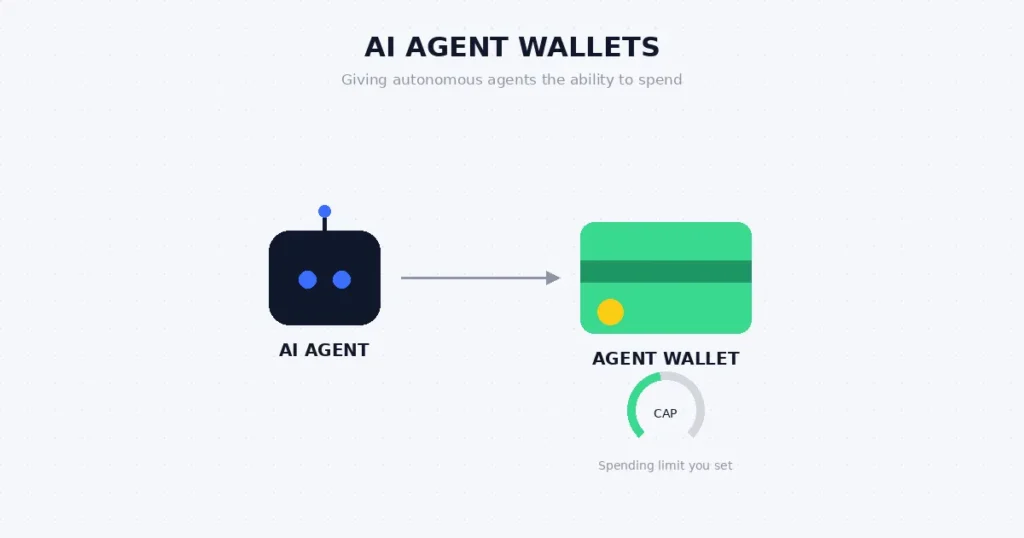
When AI Agents Start Spending Your Money
Financial autonomy for software agents is no longer theoretical. In August 2026, Cloudflare introduced native wallet infrastructure that allows an AI agent to pay for APIs, data, and digital services without a human approving each transaction. AWS added comparable functionality through its AgentCore Payments system shortly afterward.
This marks a genuine inflection point. Every agent framework built to date has been designed for humans to remain in the payment loop. A workflow could draft a purchase order, summarize an invoice, or recommend a vendor — but a human always clicked the final confirmation button. That assumption no longer holds.
Quick Answer: AI agent wallets are real, and the risks are equally real. Runaway reasoning loops can trigger repeated paid API calls faster than any human would notice. Before connecting any wallet to a live agent, set a hard total spending cap, an approved vendor list, and a real-time kill switch. The infrastructure is powerful and will become standard across the industry — but deploying it without guardrails is a serious financial and security risk.
This guide explains what agent wallets are, how the x402 payment protocol works under the hood, and the concrete steps required to deploy this capability safely.
Disclosure: Operant Solo is reader-supported. We may earn an affiliate commission when you purchase through links on this page, at no additional cost to you. Recommendations are based on independent testing and evaluation.
What Are AI Agent Wallets?
An agent wallet is a programmable digital wallet attached directly to an AI agent instance. Rather than storing funds for a human user, it stores funds on behalf of an automated software process.
When the agent encounters a paid API or a gated data source, it draws from the wallet autonomously. No checkout page appears. No human receives a notification asking for approval. The transaction executes and the agent continues its task.
This pattern solves a genuine problem. Autonomous research agents that scrape paid data sources, coding agents that spin up cloud infrastructure, and procurement agents that purchase digital licenses all previously required manual payment steps. Those friction points broke the autonomous loop and eliminated much of the efficiency gain from running an agent in the first place.
Agent wallets remove that friction — but removing friction from spending is a risk that demands careful design.
The x402 Protocol: How Payment Works Inside an Agent Loop
The mechanism enabling this capability is the x402 protocol. Understanding it explains both the power and the danger of agent wallets.
In standard HTTP, a server returns a 402 Payment Required status code when a resource requires payment. This code has existed since the early days of the web but was never widely implemented because the payment experience for humans is handled through checkout flows, not API responses.
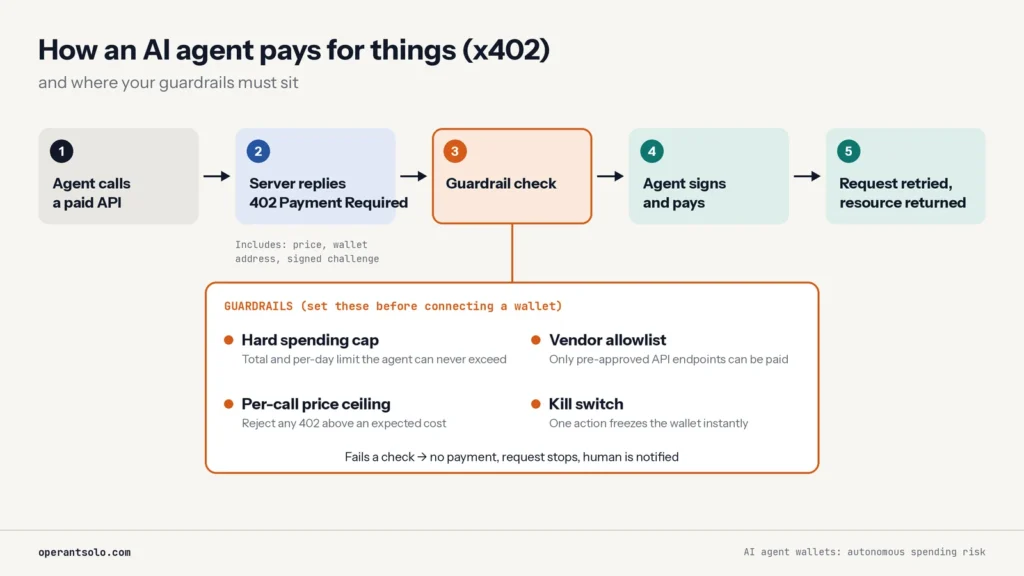
The x402 protocol gives that dormant status code a functional implementation. When an agent makes a request to a paid API endpoint, the server responds with a 402 response that includes:
- The exact cost of the requested resource.
- The accepted payment methods and wallet address.
- A cryptographic challenge the agent must sign to prove it controls the funds.
The agent’s agent framework processes this response, validates that the cost falls within its authorized spending parameters, signs the transaction, and retransmits the request with payment attached. The entire exchange completes in milliseconds.
From the agent’s perspective, a paid API endpoint behaves identically to a free one — except that funds leave the wallet with each call.
The Core Risk: Runaway Spending Loops
The efficiency of this design is also its primary vulnerability.
Consider an agent tasked with competitive research. It is instructed to gather pricing data from ten competitor websites. Seven return free data. Three are gated behind a paid API that charges per query. Without explicit spending controls, the agent calls each paid API once, extracts the data, and the task completes. Cost: minimal.
Now consider what happens when the task prompt is ambiguous, or when the agent’s reasoning loop encounters an unexpected API response and retries the call. In a human-supervised workflow, a developer would notice the loop and intervene. In a fully autonomous agent workflow, the same API endpoint can be called hundreds of times before any monitoring alert fires.
This is not a hypothetical edge case. Any agent framework that handles retries automatically — which most do, to maintain resilience — can trigger significant unplanned charges if the spending layer lacks hard limits.
Three Failure Modes to Design Against
1. Reasoning loops: The agent receives an ambiguous API response, cannot determine whether its task succeeded, and retries the paid call until it hits a timeout or an error threshold. If neither threshold exists, the loop continues.
2. Scope creep: The agent interprets a broad instruction as permission to query every potentially relevant data source. Each source charges per query. A task that should cost a few cents costs several dollars because the agent’s definition of “relevant” is wider than the operator intended.
3. Compromised prompts: A malicious instruction injected through user input or an external data source directs the agent to call a high-cost endpoint repeatedly. Because the agent’s spending authority is real, the attack has direct financial consequences.
Spending Controls: The Non-Negotiable Guardrails
Before connecting a wallet to any agent, regardless of how mature the agent framework appears, four controls must be in place.
1. Hard Total Spending Cap
Set an absolute ceiling on what the agent can spend in a given period — per hour, per day, and per task execution. When the agent reaches this ceiling, it halts and logs the event. It does not attempt to continue or request additional funds. This control eliminates the runaway loop risk entirely.
2. Approved Vendor List
Restrict which endpoints the wallet will pay. If the agent is authorized to purchase data from three specific providers, its wallet should reject payment requests from any other destination. This control prevents scope creep and limits the blast radius of a compromised prompt.
3. Per-Transaction Maximum
Set a maximum amount the agent can spend in a single transaction. If a data source charges $0.01 per query and the wallet refuses any single transaction above $1.00, a loop would need to complete 100 unauthorized iterations before spending $100. That ceiling provides time for monitoring to detect and halt the issue.
4. Real-Time Monitoring and Kill Switch
Build a monitoring workflow that tracks spending in real time and sends an alert the moment the rate of expenditure exceeds normal parameters. Include a kill switch that can suspend the agent’s wallet access immediately without requiring a code deployment or a server restart.
These four controls are not optional refinements. Any deployment without all four in place carries meaningful financial risk.
Compatibility with n8n and Make
As of mid-2026, neither n8n nor Make natively support agent wallet connections. The infrastructure from Cloudflare and AWS is primarily aimed at custom-built agent systems using direct SDK integrations and code-level agent framework configurations.
This will change. The underlying protocols — particularly x402 — are standardized and open. Expect native wallet nodes to appear in mainstream automation platforms within the next one to two years as adoption matures and security patterns stabilize.
For builders who want to experiment now, the path involves connecting n8n to a custom agent via the HTTP Request node or a Code Node, with the wallet controls implemented in the custom agent layer rather than inside n8n itself.
Should You Use Agent Wallets Today?
The answer depends on your risk tolerance and technical depth.
Deploy now if:
- You are building a custom agent in a controlled environment where you control the full stack.
- You have implemented all four guardrails described above.
- The use case involves low-cost, high-frequency queries where the efficiency gain from removing human approval steps is measurable and significant.
Wait if:
- Your agent receives instructions from external sources (users, emails, web scraping) where prompt injection is a realistic attack vector.
- You do not have real-time monitoring infrastructure in place.
- Your team is not yet comfortable auditing agent reasoning logs to identify unexpected spending patterns.
The capability is genuinely powerful. The infrastructure is production-ready. But agent wallets are not a plug-and-play feature — they are a financial instrument attached to autonomous software, and they warrant the same deliberate design process as any payment integration designed for humans.
Frequently Asked Questions
What are AI agent wallets?
Agent wallets are programmable digital wallets attached to an AI agent rather than a human user. They allow an agent to pay for APIs, data sources, and digital services autonomously within spending limits configured by the operator — without requiring manual approval for each transaction.
Are AI agent wallets safe to use?
They are safe when deployed with proper controls: a hard total spending cap, an approved vendor list, a per-transaction maximum, and real-time monitoring with a kill switch. Without these controls, a reasoning loop gone wrong can trigger repeated paid API calls faster than any human would detect.
Can I use agent wallets with n8n or Make?
Not natively as of late 2026. The infrastructure from Cloudflare Wallets and AWS AgentCore Payments targets custom-built agent systems rather than visual automation platforms. Expect native integration within mainstream tools over the next one to two years as the x402 protocol matures.
What is the x402 protocol?
The x402 protocol is an implementation of the long-dormant HTTP 402 status code. When an agent requests a paid resource, the server responds with the price, accepted payment method, and a cryptographic challenge. The agent’s agent framework validates the cost against its spending parameters, signs the transaction, and completes the request — all within milliseconds.
How is this different from a standard API key with billing?
A standard API key is linked to a human-controlled billing account. A human receives invoices, reviews charges, and makes payment decisions. An agent wallet is held and managed by the agent itself. The agent makes payment decisions autonomously within its configured parameters. The removal of the human from the payment loop is both the efficiency gain and the source of the risk.
Related Reading:
- n8n Human in the Loop: How to Safely Control AI Agents →
- n8n Security Vulnerabilities 2026: Is n8n Safe to Use? →
- Multi-Model AI Agent n8n: Build HydraFusion Patterns →
- OpenAI Structured Outputs in n8n (Fix JSON Errors) →
- How to Automate a Website Without an API Using AI Agents →
n8n
Best for: technical automation workflows
Consider n8n when your workflow needs custom logic or control over deployment. Self-hosting also requires time for updates, backups, and monitoring.
Operant Solo may earn a commission if you purchase through this link, at no extra cost to you.
Pingback: AI Agent Workflows for Solopreneurs: What's Safe to Automate in 2026
Pingback: Zapier AI Agents Review (2026): The Hidden Costs & Best Alternatives