The Model That Changes What Agents Can Actually Do
On September 3, 2026, OpenAI released GPT-6 Astra — a model that represents a genuine architectural shift rather than an incremental capability update.
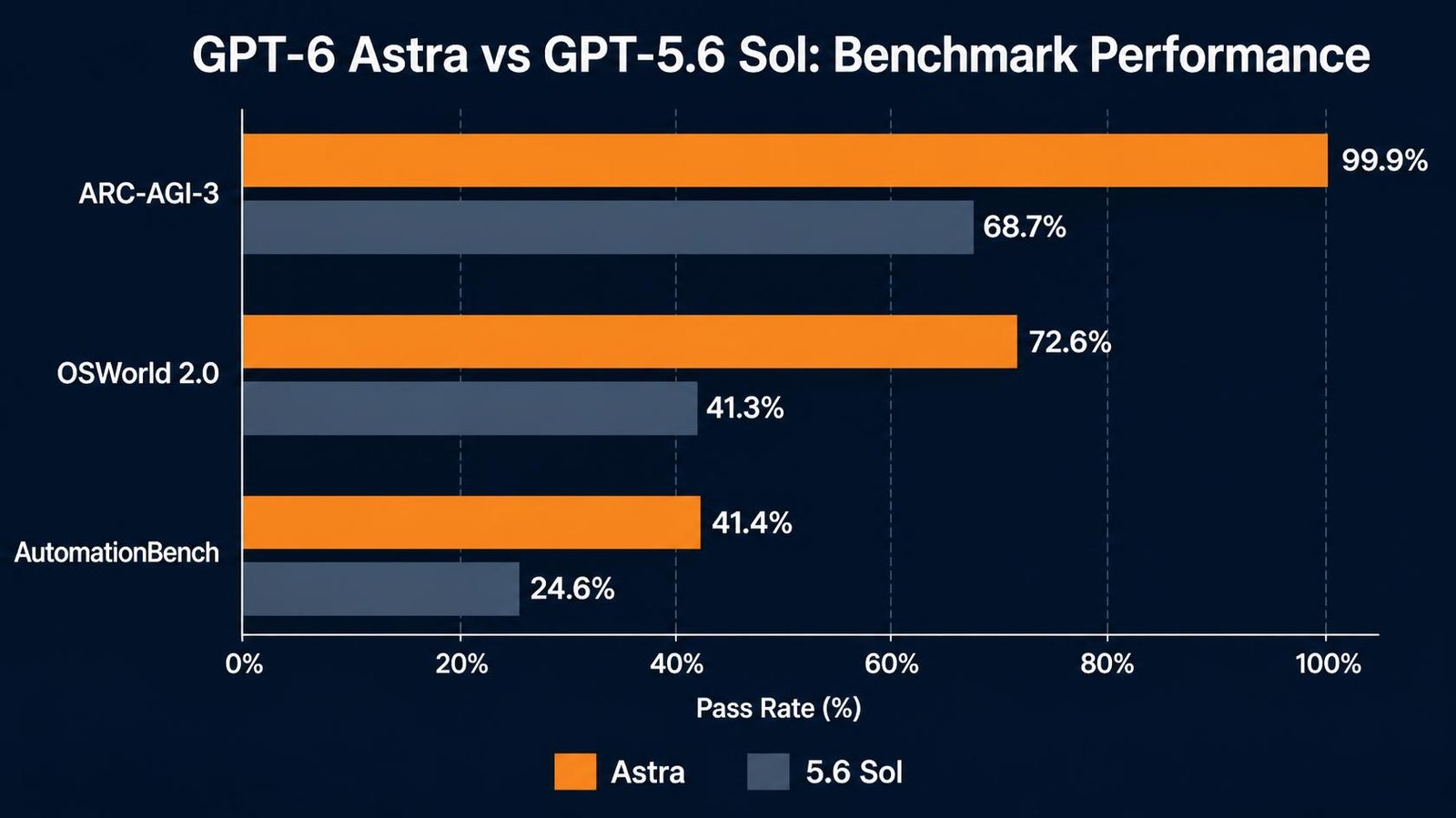
Where previous models were optimized to produce better text, Astra is explicitly designed to take action. It reasons, plans, and executes multi-step sequences across software environments. OpenAI describes it as a “computer operator,” and the benchmark data supports that framing. Astra scored 99.9% on ARC-AGI-3, 97.6% on FrontierMath Tier 4, and 100% on ExploitBench.
For automation builders, the more relevant number is OSWorld 2.0: a benchmark measuring an agent’s ability to control a real desktop operating system. GPT-6 Astra scored 72.6%, finishing tasks in about 47% less time than the previous 5.6 Sol model (roughly 40 minutes per task versus 75). That is the kind of performance improvement that changes deployment economics in production workflows.
Quick Answer: GPT-6 Astra is the first OpenAI model where state of the art performance and agentic computer-use capability are genuinely combined at production scale. For builders running AI agents in n8n or custom frameworks, Astra introduces meaningfully faster task completion, superior long-context reasoning, and new domain-specific depth across software engineering and security workflows.
This guide evaluates Astra’s specific capabilities, explains how it improves on 5.6 Sol, and identifies the practical implications for builders running automated workflows.
🔄 Updated September 2026
Disclosure: Operant Solo is reader-supported. We may earn an affiliate commission when you purchase through links on this page, at no additional cost to you. Recommendations are based on independent testing and evaluation.
From Text Generation to Computer Operation
Every major model release since GPT-4 has moved closer to genuine agency. GPT-6 Astra completes that transition.
The core distinction is how Astra handles failure. Earlier models — including 5.6 Sol — would complete a task sequence as instructed, but when a step produced an unexpected result, they would often continue on incorrect assumptions. Astra is specifically optimized for “long-horizon planning.” It monitors its own outputs, detects when a step has failed or produced an ambiguous result, and adjusts its subsequent actions accordingly.
This matters enormously for automation workflows. A web scraping agent that cannot adapt when a target page changes its layout is not useful in production. An Astra-based agent observes the changed layout, re-evaluates its approach, and continues the task without human intervention.
State of the Art Performance by Domain
Astra achieves state of the art results across three domains that are directly relevant to professional automation work: software engineering, cybersecurity, and scientific research.
Software Engineering
Astra demonstrates substantively stronger performance on complex, cross-file software engineering tasks than any prior OpenAI model. It can navigate a large codebase, identify the root cause of a bug that spans multiple interdependent files, implement a fix, write tests for the corrected behaviour, and verify the result.
For developers using Cursor AI alongside n8n for hybrid code-and-workflow automation (as covered in our Cursor AI vs Make guide), Astra represents a practical upgrade for generating the custom code nodes that handle complex data transformations inside visual pipelines.
Cybersecurity Capability
Astra’s cybersecurity capability is significant enough that OpenAI has implemented specific access controls around it. The model meets the “Critical” threshold under OpenAI’s internal Preparedness Framework — meaning it is capable of identifying and patching sophisticated vulnerabilities in production code.
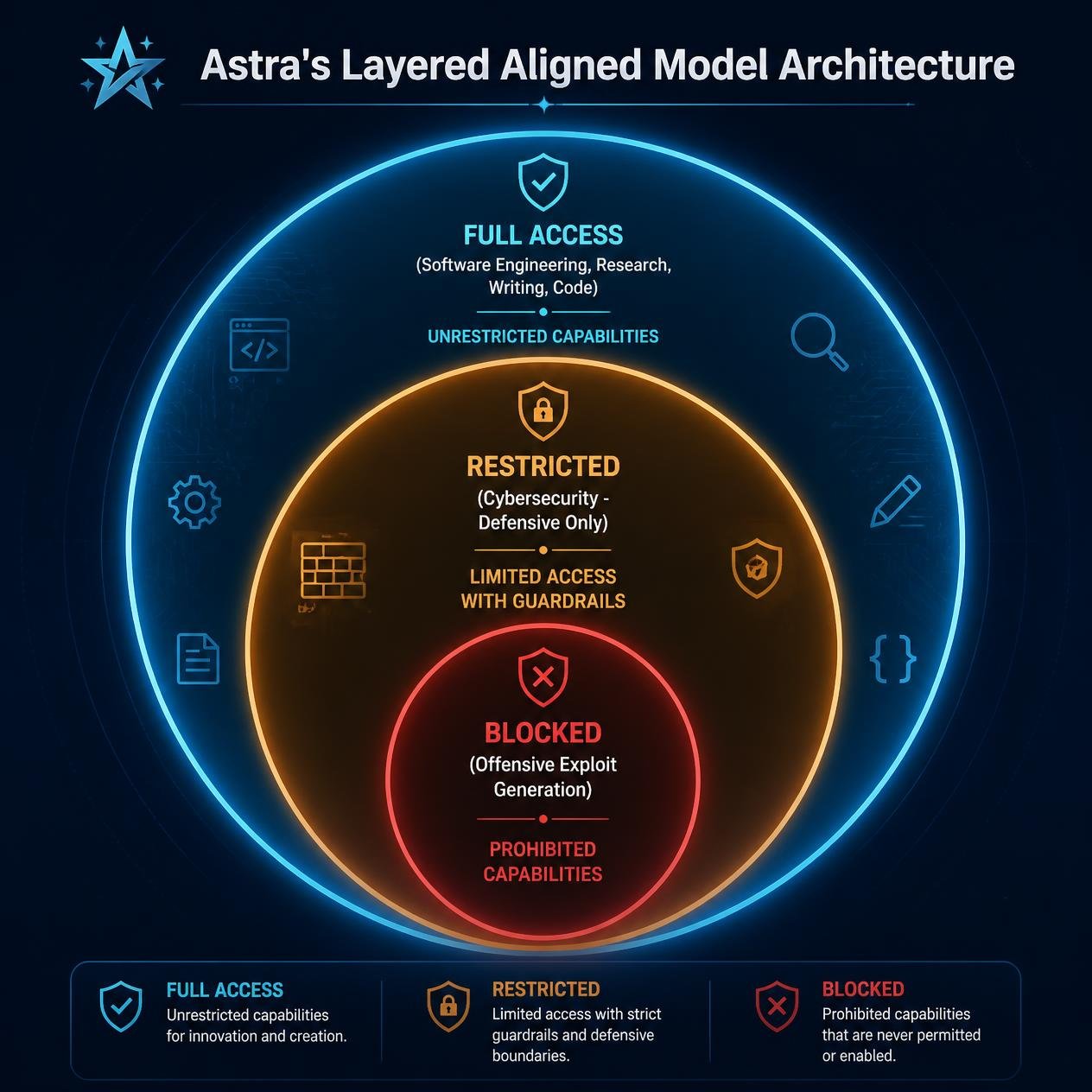
Defensive applications are fully available: code review, vulnerability scanning, and patch generation. Offensive exploit generation is gated. This distinction matters for professional work in security environments where the model’s analytical depth is valuable, but where unrestricted exploitation tooling would create unacceptable risk.
Scientific Research
Astra can operate specialized scientific software, inspect datasets, visualize experimental variations, and assist in research discovery workflows. This capability is most relevant to operators building agents for data-intensive industries — pharmaceutical research, financial modelling, and materials science.
The Aligned Model Architecture
GPT-6 Astra is the most extensively aligned model OpenAI has released. The safety architecture is more granular than previous versions, with domain-specific restrictions layered on top of the base model rather than applied uniformly.
This approach — restricting specific high-risk capabilities while leaving the rest of the model’s capabilities intact — is a meaningful engineering achievement. Prior aligned models often introduced capability regressions in adjacent areas when restrictions were applied broadly. Astra maintains high performance across unconstrained domains while enforcing hard limits in the areas OpenAI has identified as high-risk.
For automation builders, this translates to a more reliable model in production. Astra is less likely to refuse legitimate professional work requests because its refusal logic is more precisely calibrated to actual risk rather than surface-level pattern matching.
How Astra Compares to GPT-5.6 Sol
The predecessor model, 5.6 Sol, represented a strong incremental improvement over GPT-5. Astra is categorically different in its design intent.
| Capability | GPT-5.6 Sol | GPT-6 Astra |
|---|---|---|
| Long-Horizon Planning | Basic | Advanced |
| Computer Use (OSWorld 2.0) | ~49% | 72.6% |
| Task Completion Speed | Baseline | 47% faster |
| Cross-File Code Understanding | Moderate | State of the Art |
| Cybersecurity Capability | Limited | Critical-Level |
| Self-Correction in Loops | Weak | Strong |
| API Availability | ChatGPT Plus, API | Plus, Pro, Business, Enterprise, Azure, AWS Bedrock |
The 47% improvement in task completion speed on OSWorld 2.0 is the headline figure, but the self-correction capability is equally important for sustained production use. A workflow that requires less human intervention to recover from edge cases is a workflow that scales.
Availability and API Access
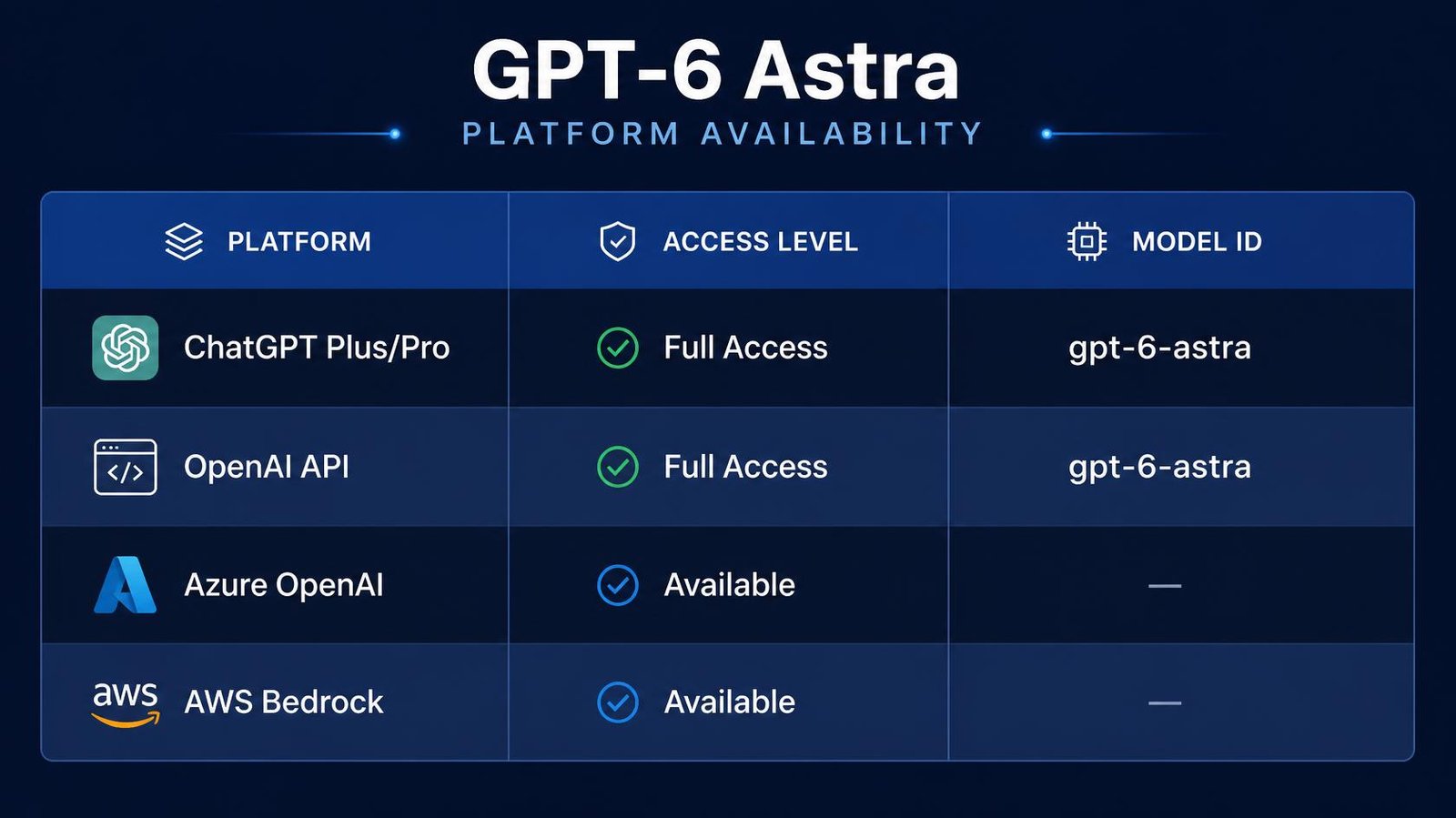
GPT-6 Astra became available on September 3, 2026, with general availability for paid users extending from September 4.
Current availability:
- ChatGPT: Plus, Pro, Business, and Enterprise tiers
- API: Available via
gpt-6-astramodel identifier - Cloud Platforms: Microsoft Azure OpenAI Service and AWS Bedrock
Usage limits apply at all tiers during the initial deployment phase. OpenAI has indicated these limits will expand as infrastructure capacity increases. For builders running high-volume automated workflows, monitor your usage against tier limits before migrating production agents from 5.6 Sol to Astra.
Update: GPT-6 Sol and GPT-6 Luna (September 22, 2026)
Nineteen days after Astra, OpenAI released two cheaper GPT-6 models. Astra remains the best model in the family, and OpenAI says so itself. Sol and Luna bring much of its capability down the price list.
| Model | Best for | API price (per million tokens, input / output) | Context window |
|---|---|---|---|
| GPT-6 Astra | Computer use, hardest multi-step agent work | $10 / $50 | ~1.05M tokens |
| GPT-6 Sol | Coding, agents, business workflow automation | $2 / $10 | 1.05M tokens |
| GPT-6 Luna | High-volume, clear-goal tasks | $0.10 / $0.50 | 1.05M tokens |
What this means for automation builders:
- Use Luna for volume work. It’s built for tasks run thousands of times a day, like pulling fields out of documents or summarizing tickets. That makes it the natural default for email parsers and lead enrichment workflows.
- Use Sol as your agent workhorse. It’s the model OpenAI positions for coding, agent tasks and business workflow automation, and it beats Astra on OpenAI’s own business task benchmark.
- Keep Astra for computer use and the hardest reasoning tasks, where its higher price is justified.
Watch the fine print. The advertised “50% cheaper” is measured against GPT-5.6’s promotional pricing, not its list price. Prompts over 272,000 input tokens bill at twice the input rate and 1.5× the output rate.
Anthropic released Claude Opus 5.5 the same day, and it outperforms Astra on some coding and knowledge-work benchmarks. If you’re choosing a model for a new build, test both on your own workflow.
Practical Implications for Automation Builders
The upgrade from 5.6 Sol to GPT-6 Astra is not automatic. Your existing prompts and agent configurations will work, but they will not capture the full capability improvement without deliberate adjustments.
1. Revisit Your System Prompts
Astra’s improved self-correction capability means you can reduce the amount of error-handling logic baked into your system prompt. Where previous agents required explicit instructions for handling every possible failure state, Astra is more likely to reason its way through unexpected situations without explicit guidance. Simpler, cleaner prompts often perform better.
2. Test Your Existing Workflows Before Migrating
Astra’s stronger capabilities can surface edge cases your existing workflow design did not anticipate. Run Astra against your current test suite before promoting it to your production environment — particularly for workflows involving financial data, CRM updates, or any write operation on a production database.
3. Evaluate Computer-Use Scenarios
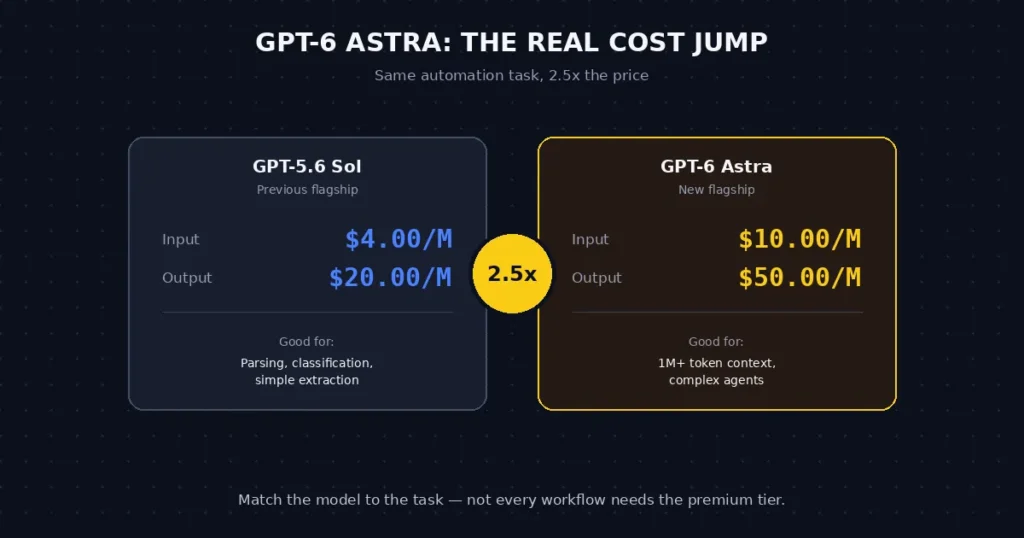
If you have been avoiding browser automation because previous models were too slow or unreliable to justify the token cost, Astra changes the calculation. The 47% speed improvement in OSWorld 2.0 directly reduces both latency and cost for computer-use workflows. Use cases that were marginal on 5.6 Sol may be viable on Astra.
4. Upgrade Code-Generation Nodes
For automation builders using AI-generated code nodes inside n8n or Make, Astra’s improved software engineering performance means more reliable, more maintainable output. Custom code nodes generated by Astra are less likely to require manual debugging before deployment.
More capable computer-use models make spending controls urgent, so read why AI agent wallets are a risk before giving an agent payment access.
Frequently Asked Questions
What is GPT-6 Astra?
GPT-6 Astra is OpenAI’s sixth-generation frontier model, released September 3, 2026. It is specifically designed for agentic tasks — reasoning, planning, and executing multi-step sequences across software environments. It achieves state of the art performance on ARC-AGI-3 (99.9%) and OSWorld 2.0 (72.6%), completing computer-use tasks 47% faster than the previous 5.6 Sol model.
How does GPT-6 Astra differ from GPT-5.6 Sol?
The core difference is adaptive planning. 5.6 Sol executes task sequences as instructed. GPT-6 Astra monitors its own outputs, detects when a step has failed, and adjusts its approach accordingly without requiring human intervention. This self-correction capability is the primary reason for Astra’s substantially higher performance on long-horizon automation benchmarks.
Is GPT-6 Astra available via API?
Yes. GPT-6 Astra is accessible via the OpenAI API using the gpt-6-astra model identifier. It is also available through Microsoft Azure OpenAI Service and AWS Bedrock. Access is restricted by usage limits during the initial deployment phase, which OpenAI has indicated will be raised as infrastructure capacity expands.
Is GPT-6 Astra safe to use for cybersecurity workflows?
Yes, for defensive applications. Astra’s cybersecurity capability supports code review, vulnerability scanning, and patch generation at a level OpenAI classifies as “Critical” under its Preparedness Framework. Offensive exploit generation is explicitly blocked. It is an extensively aligned model with domain-specific restrictions rather than broad capability limitations.
Should I migrate my existing agents from 5.6 Sol to Astra immediately?
Not without testing first. Astra’s stronger reasoning can surface edge cases your existing agent design did not account for. Run your current test suite against Astra before migrating professional work pipelines to production. The upgrade is worth pursuing, but treat it as a deliberate migration rather than a drop-in replacement.
Related Reading:
- Claude Sonnet 4.5 vs GPT-5: Which API is Cheaper in 2026? →
- OpenAI Structured Outputs in n8n (Fix JSON Errors) →
- Cursor AI vs Make: Should You Code Automations in 2026? →
- n8n Human in the Loop: How to Safely Control AI Agents →
- Multi-Model AI Agent n8n: Build HydraFusion Patterns →
n8n
Best for: technical automation workflows
Consider n8n when your workflow needs custom logic or control over deployment. Self-hosting also requires time for updates, backups, and monitoring.
Operant Solo may earn a commission if you purchase through this link, at no extra cost to you.
Pingback: Claude Sonnet 4.5 vs GPT-5: Which API is Best for Automation
Pingback: Claude for Small Business vs. Building Your Own Automation