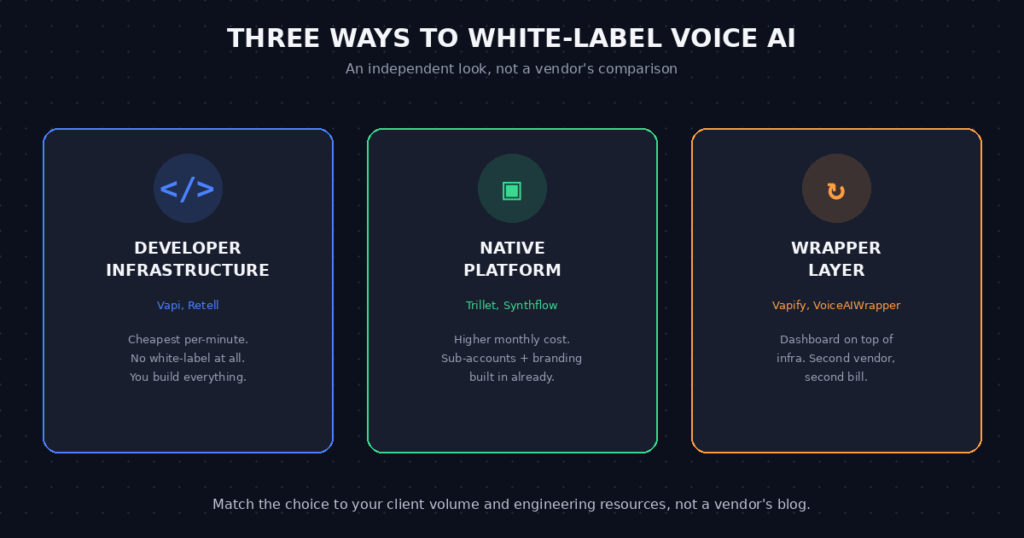
White Label Voice AI Platforms for Agencies: An Independent Comparison
The Agency Opportunity in White-Label Voice AI
The market for AI voice agents serving local businesses is growing faster than most agencies can fulfil demand. Dental clinics want an agent that books appointments. Law firms want an agent that qualifies inbound leads. HVAC companies want an agent that dispatches emergency calls after hours.
Building that agent from scratch — integrating a telephony provider, wiring up a language model, designing conversation flows, and managing server infrastructure — requires significant engineering investment. Most agency owners are not engineers, and most clients cannot wait six months for a custom build.
White label voice AI platforms solve this problem directly. Rather than building the infrastructure yourself, you license a fully built platform, apply your branding, and resell access to your clients. The platform handles the voice engine, the telephony layer, the call routing, and the infrastructure. You handle sales, onboarding, and relationship management.
Quick Answer: A strong white label ai voice agent platform must provide four things: genuine white-labelling (your logo, your custom domains, your landing page), a pricing model that allows a healthy reseller margin, robust conversation flows that non-technical users can configure, and enterprise-grade data residency controls for regulated-industry clients. This guide evaluates those criteria for the leading platforms in 2026.
Here is everything agencies need to know before committing to a white label solution for voice AI.
Disclosure: Operant Solo is reader-supported. We may earn an affiliate commission when you purchase through links on this page, at no additional cost to you. Recommendations are based on independent testing and evaluation.
What “True” White Labelling Actually Means
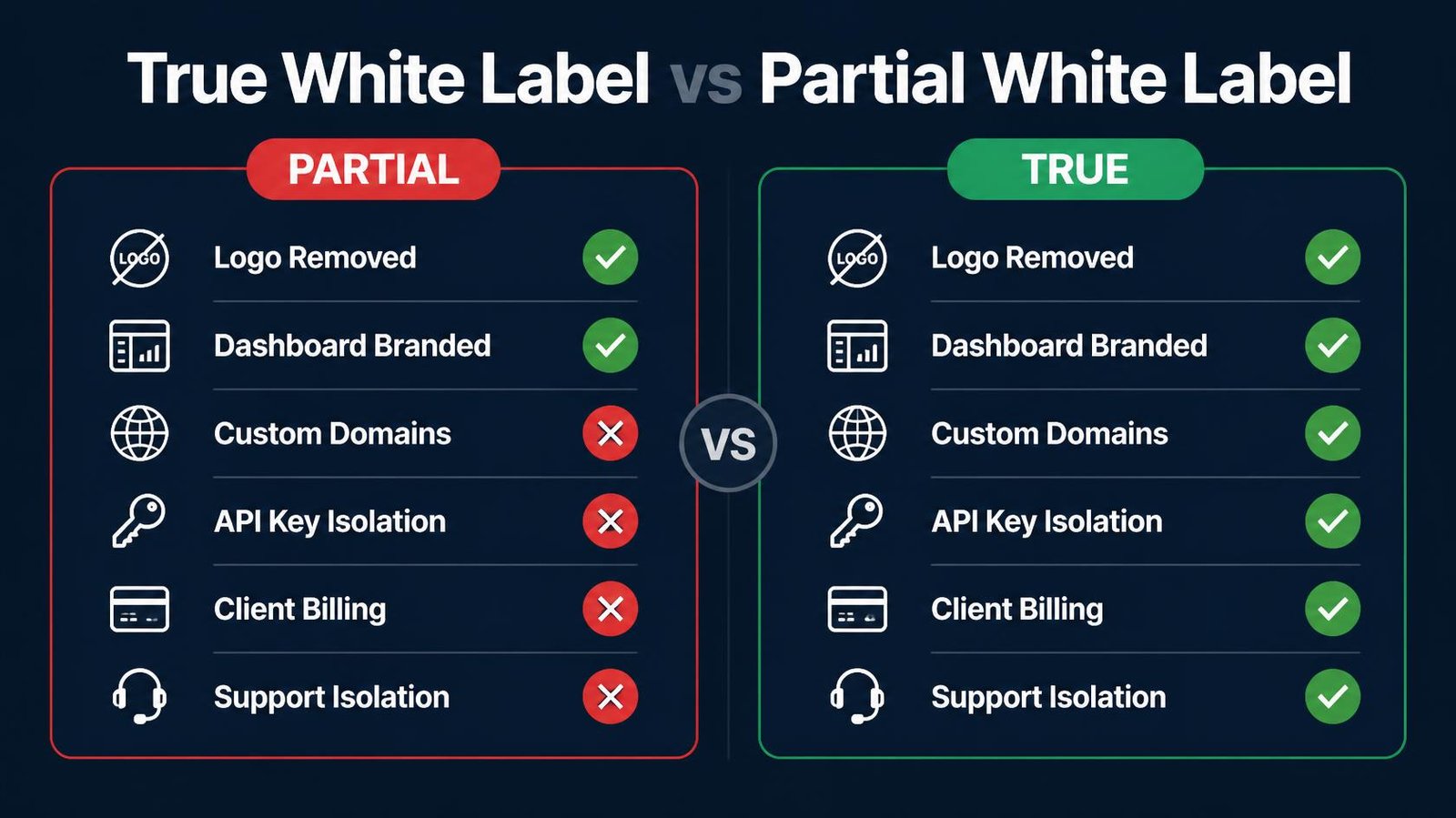
Not every platform that advertises white-label capabilities delivers genuine reseller independence. Many platforms white-label the interface only — they remove their logo from the dashboard — but leave the vendor’s branding embedded in email notifications, client-facing landing page URLs, api keys, and support portals.
Before evaluating any platform on features, confirm it delivers white labelling across all six of these touchpoints:
- Custom domains: The client dashboard must be accessible at your domain (
app.youragency.com), not the platform vendor’s domain. - Client-facing branding: All emails sent to your clients — onboarding instructions, usage reports, billing notifications — must carry your business name and logo, not the vendor’s.
- API key management: Your clients must receive api keys issued under your account, not direct credentials to the underlying platform. If a client can identify the vendor from their API credentials, they can bypass you and purchase direct.
- Support isolation: The platform must allow you to be the sole support contact for your clients. Vendor support teams should never communicate directly with your end clients.
- Automated billing: The platform must handle payment collection from your clients under your brand, or provide automated billing infrastructure that you can integrate with Stripe or another payment processor.
- Landing page: Your agency’s public-facing marketing pages must describe the product without any reference to the underlying vendor.
Agencies that settle for partial white labelling expose themselves to two risks: client poaching (the vendor acquires the client directly) and brand credibility damage (clients who discover the vendor intermediary often lose trust in the agency’s value proposition).
Which platforms offer a client-facing white label?
An API you can build on is different from a ready-made agency portal. Compare the client login, domain, subaccounts, billing, call logs and who is responsible for telephony before using the term “white label.” As of September 2026, these official product documents establish the following starting points; verify plan eligibility and contracts with each vendor.
| Route | Documented agency features | What to verify before reselling |
|---|---|---|
| Synthflow agency workspace | Subaccounts, permissions, branding and a custom domain are documented. | Which plan includes each feature, data region, phone number support and rebilling. |
| HighLevel Voice AI | Agency/subaccount access and Voice AI rebilling controls are documented. | White-label domain setup, underlying telephony charges and per-client access. |
| Vapi plus a partner portal | Vapi documents partner dashboards such as Vapify for branded portals, analytics and rebilling. | The partner’s separate fee, data handling, API-key scope, support and ownership of client accounts. |
Sources: Synthflow subaccounts, Synthflow agency dashboard, HighLevel Voice AI pricing and rebilling, and Vapi’s Vapify partner documentation. For an agency serving clients in India, test an Indian phone number, language handling, recording consent, and the actual client billing flow; do not infer local availability from a US demo.
Evaluating the Voice Engine
The voice engine is the most client-visible component of your offering. If the AI sounds robotic, pauses too long between sentences, or mispronounces common industry terms, clients will cancel regardless of how impressive the backend features are.
When evaluating the voice engine of any white label voice AI platforms you are considering, test the following four parameters.
1. Latency
Measure the time between the caller finishing a sentence and the agent beginning its response. Under 800 milliseconds feels natural in a phone conversation. Above 1,200 milliseconds feels like a lag and erodes the caller’s confidence that they are speaking with a competent system. Real time responsiveness is not optional — it is the baseline expectation.
2. Interruption Handling
A strong voice engine detects when a caller begins speaking mid-sentence and stops the agent immediately. Platforms that force the caller to wait for the agent to finish its full response before they can speak will generate complaints immediately. Test this by interrupting the demo agent mid-sentence in every evaluation call.
3. Vocabulary and Domain Customisation
Ask whether the platform allows you to add custom vocabulary — specific product names, local terminology, medical or legal jargon — to the speech recognition layer. An AI answering calls for a dermatology clinic that mispronounces “tretinoin” or “microneedling” is a liability, not an asset.
4. Voice Selection and Cloning
Evaluate the breadth of available voices and whether the platform supports voice cloning (the ability to create a custom voice for a specific client’s brand). A small business owner who has built a recognizable personal brand may want callers to hear a voice that sounds like them, not a generic synthetic voice.
Conversation Flow Architecture: Drag and Drop vs Code
The most significant operational divide among white label voice AI platforms is how conversation flows are built and maintained.
Drag and Drop Flow Builders
Most platforms aimed at non-technical agencies provide a drag and drop visual interface for building conversation flows. You create nodes (questions, responses, conditions) and connect them with arrows that define the path a conversation takes based on caller input.
Advantages: Clients can often be trained to update their own flows — adjusting hours, adding new FAQ responses, or changing appointment slots — without submitting a support ticket to your agency.
Disadvantages: Complex business logic (multi-condition routing, integration with external databases, dynamic personalisation based on CRM data) quickly exceeds what visual builders can represent cleanly. When a client’s use case becomes sophisticated, the visual builder becomes a liability.
API-First and Code-Based Flows
Platforms built for technical agencies expose their conversation flows via api keys and allow programmatic configuration. You can build flows in code, store them in version control, and deploy updates across all your clients simultaneously with a single script.
For agencies managing a large portfolio of clients, code-based flow management at scale is far more efficient than manually updating visual canvases in individual dashboards.
The strongest platforms offer both — a drag and drop builder for simple use cases and full API access for clients whose needs require programmatic control.
Outbound Calling and Batch Calling Capabilities
Inbound call handling is table stakes for any white label voice AI platforms. The agencies generating the highest revenue are those that deploy outbound campaigns for their clients.
Outbound Call Use Cases
- Appointment reminders: The agent calls patients or clients 24 hours before their scheduled appointment, confirms attendance, and offers to reschedule if needed.
- Lead follow-up: Within 90 seconds of a web form submission, the agent calls the lead, qualifies their intent, and books a sales call.
- Collections and overdue notices: The agent calls clients with overdue invoices, confirms the outstanding amount, and offers payment plan options.
- Review solicitation: After a service completion, the agent calls the customer and asks them to leave a review, providing a direct link via SMS.
Batch Calling Infrastructure
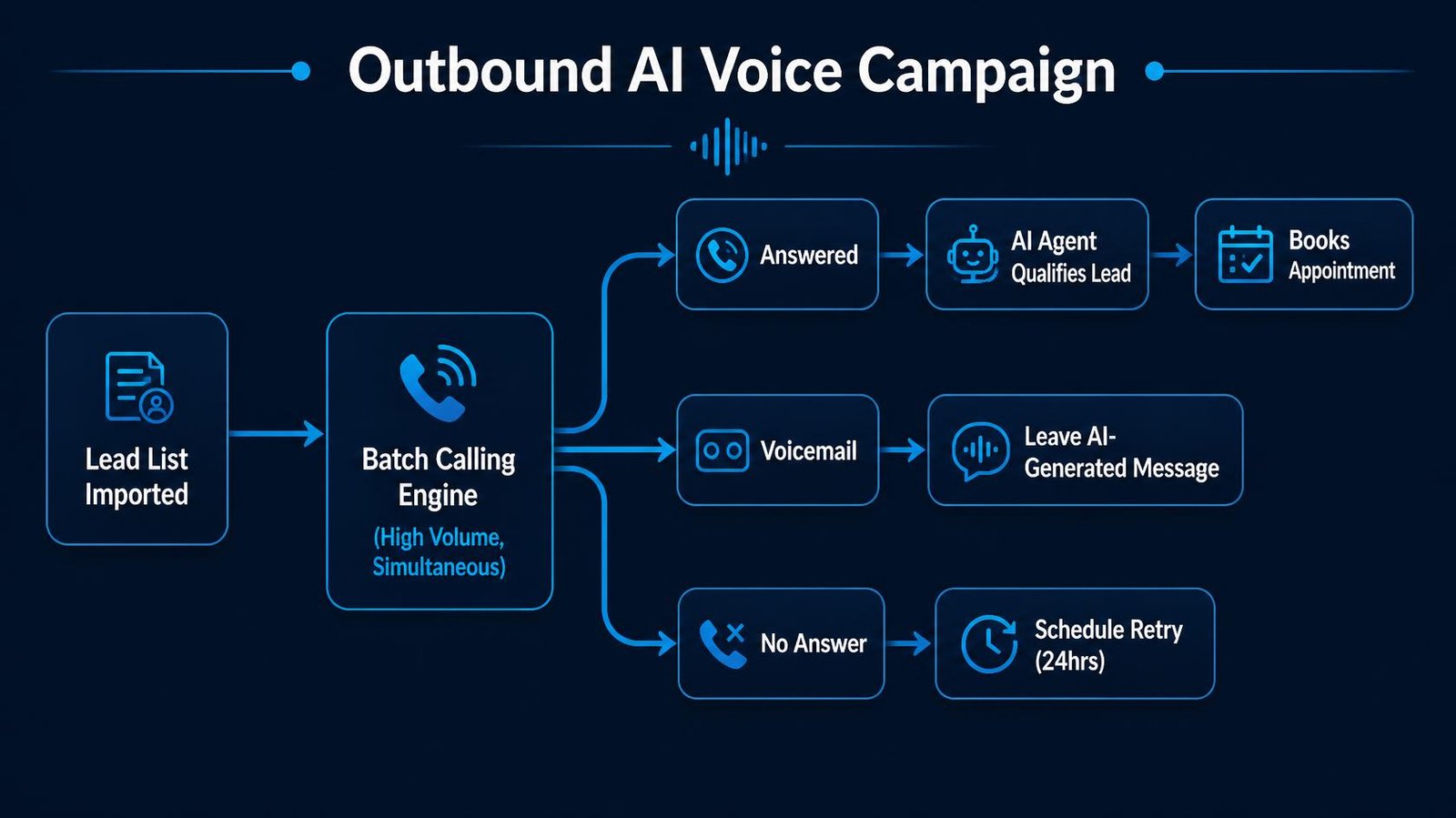
High volume outbound campaigns require batch calling infrastructure. Rather than placing calls sequentially (one after another), the platform must support simultaneous dialling — launching hundreds of concurrent outbound call sessions in parallel.
When evaluating batch calling capabilities, ask for:
- Concurrent call limits: How many simultaneous calls can the platform execute per campaign?
- Call pacing controls: Can you set a maximum dial rate to comply with TCPA regulations (in the US) or equivalent regulations in your market?
- Call result classification: Does the platform automatically classify call outcomes (Answered, Voicemail, No Answer, Wrong Number) and update the campaign accordingly?
Data Residency and Compliance
For agencies serving healthcare, legal, or financial clients, data residency is a mandatory evaluation criterion — not an optional feature comparison point.
Data residency refers to the physical location of the servers where call recordings, transcripts, and client data are stored. Regulations like HIPAA (US healthcare), GDPR (European Union), and Australia’s Privacy Act impose strict requirements on where regulated data can be processed and stored.
When evaluating white label voice AI platforms for compliance-sensitive clients:
- Ask for a Data Processing Agreement (DPA): Any reputable platform will provide a DPA that explicitly identifies the jurisdictions where data is stored and processed.
- Confirm call recording storage location: Call recordings are the most sensitive data type. Ensure they are stored in the same jurisdiction as the client’s primary market.
- Evaluate data deletion controls: GDPR and similar regulations require the ability to delete all data associated with a specific individual on request. Confirm the platform provides per-user data deletion via the dashboard or api keys.
- Assess zero data retention policies: For the highest-sensitivity clients, some platforms offer zero data retention — transcripts are processed in memory and never written to disk. This eliminates the data residency risk entirely.
Pricing Models: What to Look for as a Reseller
The pricing model the vendor uses determines whether you can build a financially sustainable reseller business or whether you will be permanently margin-compressed.
Per-Minute Pricing
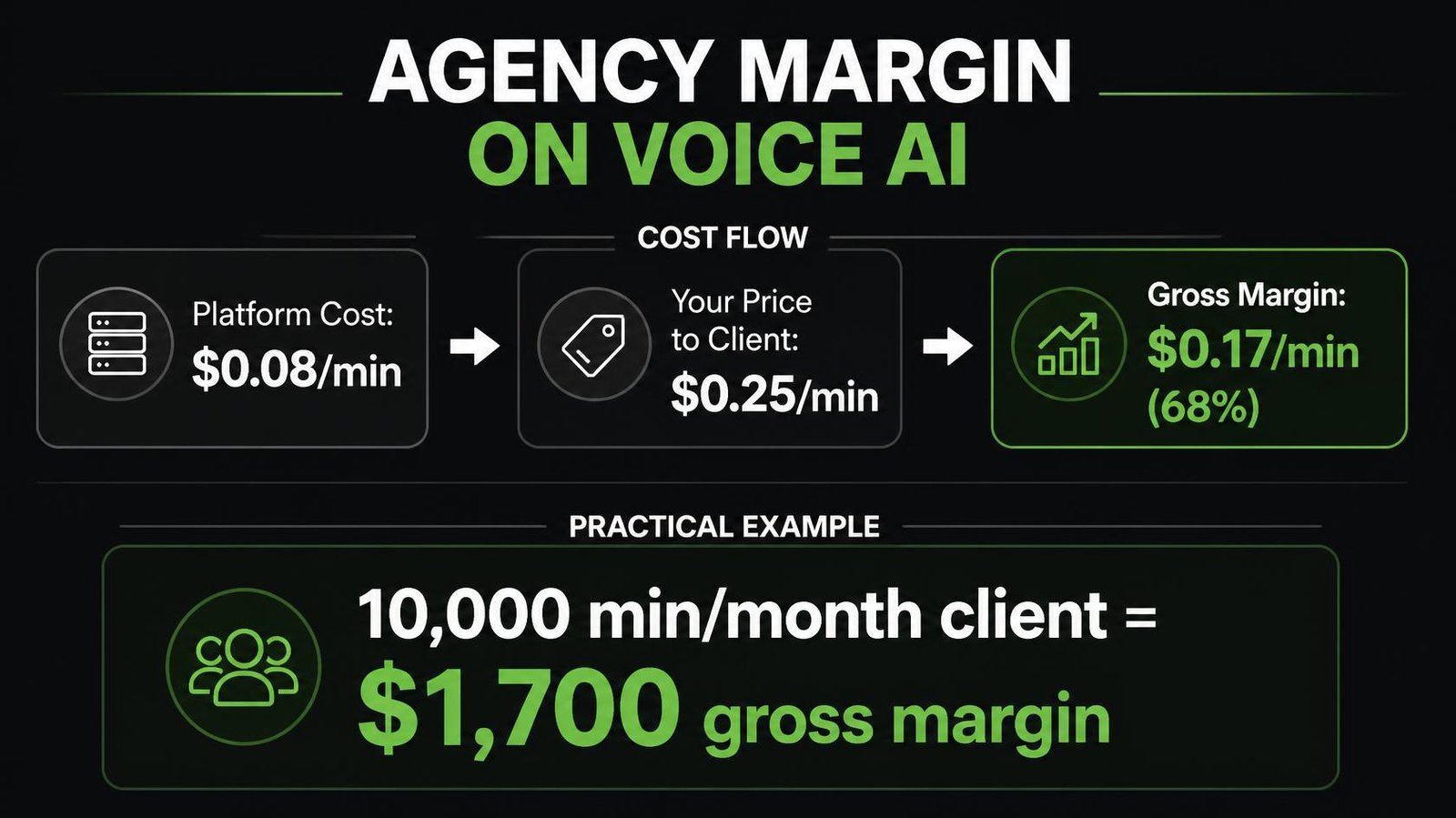
The most common model. The vendor charges you per minute of call time (typically $0.05–$0.15 per minute). You mark this up to your client (typically $0.20–$0.35 per minute).
Advantage: Your costs scale directly with client usage. Low-volume clients are inexpensive to serve. Disadvantage: At high volume, minute-based costs accumulate rapidly. A client running a batch calling campaign of 10,000 calls at 3 minutes average duration generates 30,000 minutes — a significant cost that must be correctly priced before the campaign runs.
Subscription + Usage Overage
A flat monthly platform fee per client (covering a baseline call minute allocation) with overage charges for usage above the allocation.
Advantage: Predictable base revenue. Easier to model client profitability. Disadvantage: Clients who consistently exceed their allocation require careful overage management, or the overage charges erode your margin.
Revenue Share
Some platforms charge agencies a percentage of the revenue they collect from clients rather than a per-minute fee.
Advantage: Zero upfront cost. No margin compression on low-volume months. Disadvantage: At scale, revenue share becomes extremely expensive. A platform taking 20% of your client revenue is more expensive than per-minute pricing once monthly billings exceed a few thousand dollars.
Implementation: From Signup to First Client
Once you have selected a platform, the path from signup to your first live client deployment follows a consistent pattern across most white label solution providers.
Week 1 — Platform Configuration: Provision your white-label environment. Configure your custom domains and connect your domain’s DNS records. Upload your agency logo and brand colours. Set up your automated billing integration with Stripe. Create your client-facing landing page that describes the service.
Week 2 — Build Your First Template Workflow: Design your first set of reusable conversation flows — a standard appointment booking flow, an FAQ flow, and a lead qualification flow. These become the templates you deploy for every new client, reducing onboarding time from days to hours.
Week 3 — Connect Your Orchestration Layer: Integrate the platform with n8n to handle backend data flows. When an agent books an appointment, n8n catches the webhook and pushes the booking to the client’s calendar system. When a lead is qualified, n8n updates the CRM and sends a notification to the sales team.
Week 4 — Launch Your First Pilot Client: Deploy the platform for one client at no cost or a heavily reduced rate. Document every configuration decision and support ticket. This pilot builds your onboarding playbook and surfaces the edge cases you will encounter at scale before they affect paying clients.
If you’d rather build your own stack than resell a platform, see how to build an AI voice receptionist from scratch.
Frequently Asked Questions
What are white label voice AI platforms?
White label voice AI platforms are fully built AI phone agent systems that agencies license and resell under their own branding. The vendor provides the voice engine, telephony infrastructure, conversation flows builder, and api keys. The agency provides the branding, client relationships, and pricing. Clients interact exclusively with the agency’s brand and never see the underlying platform vendor.
What should I look for in a white label AI voice agent platform?
A strong white label ai voice agent platform must offer genuine white labelling across custom domains, email communications, and api keys; a pricing model that supports healthy reseller margins; drag and drop flow building for non-technical clients; batch calling for outbound campaigns; and data residency controls for compliance-sensitive industries.
How does automated billing work in white label platforms?
Automated billing on a well-designed white label solution allows you to set per-client pricing independently from your platform costs. Clients are billed automatically each month at your set rate. The platform collects from your clients under your brand, then bills you at the wholesale rate, keeping the margin difference as your revenue.
What is the typical pricing model for reselling voice AI?
Most agencies use a per-minute pricing model, marking up the platform’s wholesale rate (typically $0.05–$0.15 per minute) to a client-facing rate of $0.20–$0.35 per minute. Many agencies layer a monthly platform fee on top of usage charges to create predictable base revenue and offset their fixed costs.
Can a white label voice AI platform handle high volume outbound campaigns?
Yes, provided the platform supports true batch calling with concurrent dialling. Confirm the platform’s simultaneous call limit, call pacing controls for regulatory compliance, and result classification capabilities before committing to high volume outbound use cases with clients.
Related Reading:
- How to Build an AI Receptionist Agency →
- n8n vs Make (2026): Which is Better for AI Automation? →
- AI Lead Enrichment: How to Automate Client Research →
- Automate Your Freelance Business with n8n →
- Zapier AI Agents Review (2026): The Hidden Costs & Alternatives →
- Best AI Receptionist Platforms in 2026: Buyer’s Guide →
n8n
Best for: technical automation workflows
Consider n8n when your workflow needs custom logic or control over deployment. Self-hosting also requires time for updates, backups, and monitoring.
Operant Solo may earn a commission if you purchase through this link, at no extra cost to you.
Vapi
Best for: developers building voice-agent workflows
Consider Vapi when you want an API-based approach to building a voice workflow. Evaluate the telephony, model, and usage costs alongside the implementation effort.
Operant Solo may earn a commission if you purchase through this link, at no extra cost to you.
Pingback: How to Start an AI Receptionist Agency in 2026 (Real Costs & Stack)
Pingback: Pipedream vs Zapier (2026): Which Should Solopreneurs Actually Use?
Pingback: Why US AI Voice Bots Fail at Hinglish ai receptionist
Pingback: Best Hinglish AI Receptionist for Dentists: 2026 Guide
Pingback: Best AI Receptionist in Hinglish: 2026 Comparison & Trial Guide
Pingback: Affordable AI Voice Receptionist: The Real Cost in 2026
Pingback: AI Voice Receptionist Pricing: 2026 Costs and Build Guide
Pingback: AI Receptionist for Dental Clinics Demand: 2026 Guide
Pingback: AI Receptionist for Salons & Spas India: Automate Bookings